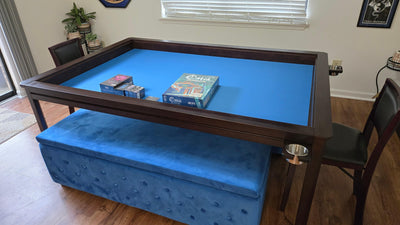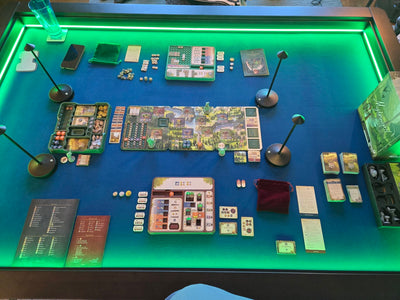
How Much Space Does a Gaming Table Really Need?
How much space does a gaming table really need? As a starting point, allow approximately 30–36 inches of clearance from the external table edge to the nearest wall or obstruction on sides where players need to sit and move.
A gaming table with external dimensions of 3 × 5 feet generally requires a clear area of around 8 × 10 to 9 × 11 feet, while a 4 × 6 foot table requires approximately 9 × 11 to 10 × 12 feet under the same planning assumptions.
Additional space may be necessary for storage furniture, larger chairs, doorways, accessibility, and walking behind seated players.
The size of a gaming table is only part of its actual footprint. Chairs, player movement, storage access, and the games you regularly play all influence how much room your gaming setup needs.
This guide explains how to calculate gaming table room requirements, compare common table dimensions, and determine whether your available space can comfortably accommodate your preferred table.

Gaming Table Room Size: Quick Answer
3 × 5 ft Table
Example clear area with 30 inches of clearance on all four sides.
With 36-inch clearance: 9 × 11 ft.
4 × 6 ft Table
Example clear area with 30 inches of clearance on all four sides.
With 36-inch clearance: 10 × 12 ft.
4 × 8 ft Table
Example clear area with 30 inches of clearance on all four sides.
With 36-inch clearance: 10 × 14 ft.
Table of Contents
- Measure the Table Plus People
- How Much Clearance Do You Need Around a Gaming Table?
- How to Calculate Gaming Table Room Size
- Gaming Table Dimensions and Room Size Chart
- What Gaming Table Size Fits Your Room?
- Match Surface Size to Game Type
- Keep Storage Out of the Seating Path
- Gaming Table Options for Small Rooms
- Tape the Footprint Before Buying
- Gaming Table Measurement Checklist
- Find the Right BoxKing Gaming Table
- Frequently Asked Questions
1. Measure the Table Plus People
A gaming table can technically fit inside a room and still feel uncomfortable once players sit down. The actual footprint includes the table, chairs, player movement, and access to surrounding furniture.
Before comparing gaming table dimensions , understand the difference between the internal playing area and the external furniture footprint.
Internal Playing Area
The usable surface where you place game boards, cards, miniatures, terrain, and player components.
This measurement helps determine which games can comfortably fit on the table.
External Table Dimensions
The full width and length of the furniture, including its outer frame and rails.
This measurement determines how much physical floor space the table occupies.
Internal vs. External Gaming Table Dimensions
A 3 × 5 gaming table can work well for many board games, card games, and smaller RPG sessions.
A 4 × 6 gaming table may provide additional playing space for larger strategy games, miniatures, and games with individual player boards.
However, the advertised playing dimensions should never be treated as the external furniture dimensions without checking the specific product measurements.
2. How Much Clearance Do You Need Around a Gaming Table?
Approximately 30–36 inches of clearance between the external table edge and the nearest obstruction is a useful starting point for seating and movement.
If people regularly need to walk behind occupied chairs, consider allowing more space, depending on the chair depth and room layout.

Gaming Table Clearance Guidelines
| Table-to-Obstruction Clearance | Planning Consideration | Suitable Situation |
|---|---|---|
| 24 inches | Very restricted space | Unseated or low-traffic sides where movement is not normally required |
| 30 inches | Basic seating clearance | Compact layouts with limited traffic behind chairs |
| 36 inches | More room for seating and movement | General family and board game room setups |
| 42–48 inches or more | Additional circulation space | Areas with frequent movement behind occupied chairs |
Gaming Table and Chair Clearance Diagram
Illustrative layout, not drawn to scale. Clearance includes the space occupied by chairs.
Measure the Chairs Separately
A common mistake is assuming that 36 inches of table-to-wall clearance also provides 36 inches of walking space behind a seated player.
In reality, the chair and player occupy part of that clearance. If an occupied chair extends 22 inches from the table edge, a total clearance of 36 inches leaves only about 14 inches behind the chair.
Walking Space Behind a Chair
Remaining Walking Space = Table-to-Wall Clearance − Occupied Chair Depth
Example: 36 inches − 22 inches = 14 inches.
Measure your actual chairs in their occupied position before deciding how much clearance your gaming room needs.
3. How to Calculate Gaming Table Room Size
You can estimate the space required for a gaming table using its external dimensions and the clearance needed on each side.
Gaming Table Room Size Formula
Required Clear Width = External Table Width + Left Clearance + Right Clearance
Required Clear Length = External Table Length + Front Clearance + Rear Clearance
Example 1: Room Size for a 3 × 5 Gaming Table
Assume a table has actual external dimensions of 36 × 60 inches.
With 30 inches on each side:
Width: 36 + 30 + 30 = 96 inches
Length: 60 + 30 + 30 = 120 inches
Example 2: Room Size for a 4 × 6 Gaming Table
Assume a table has actual external dimensions of 48 × 72 inches.
With 36 inches on each side:
Width: 48 + 36 + 36 = 120 inches
Length: 72 + 36 + 36 = 144 inches
Example 3: Add Board Game Storage
If you plan to place a 16-inch-deep storage unit along one side of a gaming table, include that furniture depth in your room calculation.
External table width: 48 inches
Left clearance: 36 inches
Right clearance: 36 inches
Storage furniture depth: 16 inches
Total width: 48 + 36 + 36 + 16 = 136 inches
This example shows why a room that fits a gaming table may still need additional space once board game shelves and other furniture are included.
For more furniture placement advice, see our complete board game room setup guide .
4. Gaming Table Dimensions and Room Size Chart
The following gaming table size chart compares common example external dimensions with the clear floor area required for different clearance allowances.
| External Table Size | 30" Clearance | 36" Clearance | 42" Clearance |
|---|---|---|---|
| 3 × 4 ft | 8 × 9 ft | 9 × 10 ft | 10 × 11 ft |
| 3 × 5 ft | 8 × 10 ft | 9 × 11 ft | 10 × 12 ft |
| 4 × 5 ft | 9 × 10 ft | 10 × 11 ft | 11 × 12 ft |
| 4 × 6 ft | 9 × 11 ft | 10 × 12 ft | 11 × 13 ft |
| 4 × 8 ft | 9 × 13 ft | 10 × 14 ft | 11 × 15 ft |
Which Gaming Table Size Should You Consider?
| Example Table Size | Potential Use | Planning Priority |
|---|---|---|
| 3 × 4 ft | Compact board games and card games | Small footprint and player reach |
| 3 × 5 ft | Family games and smaller RPG sessions | Balance playing space and room size |
| 4 × 5 ft | Games requiring additional width | Player reach across the table |
| 4 × 6 ft | Larger strategy games and group gaming | Seating and component space |
| 4 × 8 ft | Large gaming setups and hobby activities | Room length and circulation |
For additional guidance on choosing a table based on your games and room dimensions, read how to choose the right board game table size for your room .
5. What Gaming Table Size Fits Your Room?
If you already know your available room dimensions, you can reverse the calculation to estimate the maximum external table size that may fit.
Maximum Gaming Table Size Formula
Maximum Table Width = Available Clear Room Width − Total Side Clearance
Maximum Table Length = Available Clear Room Length − Total End Clearance
| Available Clear Room Size | Maximum External Table Size with 30" Clearance | Maximum External Table Size with 36" Clearance |
|---|---|---|
| 8 × 10 ft | 3 × 5 ft | 2 × 4 ft |
| 9 × 11 ft | 4 × 6 ft | 3 × 5 ft |
| 10 × 12 ft | 5 × 7 ft | 4 × 6 ft |
| 11 × 13 ft | 6 × 8 ft | 5 × 7 ft |
| 12 × 14 ft | 7 × 9 ft | 6 × 8 ft |
Can a 4 × 6 Gaming Table Fit in a 10 × 12 Room?
Yes, if the table's actual external dimensions are 4 × 6 feet and the full 10 × 12 foot area is available, the layout provides 36 inches of clearance on all four sides.
However, if the advertised 4 × 6 dimensions describe the internal playing area, the actual furniture footprint may be larger. Existing shelves, cabinets, and door swings may also reduce the usable space.
Example 10 × 12 Foot Gaming Room Layout
The room and table footprints are proportional. Chairs are illustrative and must be measured separately.
6. Match Gaming Table Surface Size to Game Type
Room size determines whether a gaming table fits physically, but your gaming habits determine whether the playing surface is large enough.
A larger table is not automatically better. Players should be able to reach game components, interact comfortably, and access their individual playing areas.
| Game Type | Space Requirements | Table Selection Priority |
|---|---|---|
| Card games | Cards, decks, and small player areas | Comfortable player interaction |
| Family board games | Central board and player components | Balanced surface size and reach |
| Strategy board games | Large boards, cards, and player mats | Usable playing area |
| Dungeons & Dragons | Maps, dice, character sheets, and DM equipment | Player zones and equipment space |
| Miniature wargames | Battlefields, terrain, and miniatures | Required battlefield dimensions |
| Large campaign games | Multiple boards and persistent game components | Surface capacity and game preservation |

Test Your Largest Regularly Played Game
Before choosing a gaming table, set up your most space-demanding regularly played game on an existing surface.
Include space for:
- The central game board or battlefield.
- Individual player boards and character sheets.
- Card decks and discard piles.
- Dice, tokens, miniatures, and terrain.
- Rulebooks and frequently used accessories.
- Comfortable player reach and movement.
Measure the total occupied playing area and compare it with the internal playing dimensions of your preferred gaming table.
Compatible gaming table accessories may help preserve usable playing space by providing dedicated locations for drinks, cards, dice, and other components.
7. Keep Storage Out of the Seating Path
Board game storage is part of the room's functional footprint. If shelves sit directly behind occupied chairs, players may need to move whenever someone retrieves a game or accessory.

Account for Storage Depth and Access
- Measure the full external depth of shelves and cabinets.
- Include space for opening cabinet doors and drawers.
- Keep frequently played games accessible without blocking chairs.
- Avoid placing large storage furniture in primary walking routes.
- Allow enough space to remove large and heavy board game boxes safely.

If your collection requires additional storage, explore BoxKing's board game storage solutions and GameKeep modular shelving .
For practical game classification and storage advice, read our guide on how to organize a game room .
8. Gaming Table Options for Small Rooms
A small room does not necessarily mean you cannot have a dedicated tabletop gaming setup. The key is choosing furniture that matches the available space and your gaming habits.
Choose a Compact Gaming Table
A smaller gaming table can be a better choice when the room needs to accommodate seating, storage, and everyday activities.
Prioritize the usable playing area required by your regular games instead of choosing the largest table that can physically fit.
Consider a Gaming Coffee Table

If your room cannot accommodate a separate full-size gaming table, a gaming coffee table with a removable topper may be a practical alternative for casual gaming and shared living spaces.
Check the table height, playing dimensions, seating arrangement, and accessibility before deciding whether a coffee table setup suits your group.
Use Multifunctional Gaming Furniture
A gaming table that also supports dining or everyday activities can reduce the need for separate pieces of furniture.
A compatible removable topper can allow the same table to serve different purposes, depending on the table's design and the clearance available beneath the topper.
If a second full-size table is not practical, a tabletop gaming surface designed for use on compatible existing furniture may also be worth considering. Check its external dimensions, support requirements, and compatibility with your existing table.
Read our guide to choosing a board game table for an apartment for additional small-space furniture ideas.
9. Tape the Footprint Before Buying a Gaming Table
One of the most effective ways to determine whether a gaming table fits your room is to simulate its footprint before purchasing.
You only need a tape measure, removable floor-safe tape, and the chairs you plan to use.
Step 1: Mark the Table
Use the manufacturer's actual external table dimensions to mark the full furniture footprint on the floor.
Step 2: Add the Chairs
Position chairs around the marked area. Test their normal seated and pulled-out positions.
Step 3: Test Movement
Walk around the occupied seating positions. Check whether players can enter, leave, and access surrounding furniture.
Step 4: Check Storage and Doors
Open nearby cabinets, drawers, and doors. Make sure the proposed table layout does not interfere with their normal use.
Test a Real Game Night Scenario
Ask several members of your gaming group to sit around the marked table footprint. Simulate reaching for components, getting up from chairs, and retrieving games from nearby shelves.
If the layout already feels uncomfortable before the table arrives, the problem is unlikely to disappear once the room contains the actual furniture and gaming equipment.
10. Gaming Table Measurement Checklist
Before purchasing a gaming table, confirm the following measurements and practical room requirements.
- Measure the usable room width and length.
- Check the external dimensions of the gaming table.
- Check the internal playing surface dimensions.
- Measure chair width and occupied depth.
- Allow sufficient space for sitting and standing.
- Check walking routes behind occupied chairs.
- Measure existing storage furniture.
- Account for cabinet doors and drawers.
- Check the playing area required by your largest game.
- Include any accessories that extend beyond the table edge.
- Measure doorways, stairs, and delivery access.
- Check assembly space and product installation requirements.
- Test the complete footprint using removable tape.
These measurements help you choose a gaming table that fits both your room and your actual gaming needs.
11. Find the Right BoxKing Gaming Table for Your Space
The right gaming table is not necessarily the largest table available. It is the one that provides enough playing space while allowing comfortable seating, movement, and everyday room use.

Kingswood Gaming Table
Explore wooden gaming table options for board games, family game nights, and multifunctional living spaces.
Review the available sizes and actual external dimensions before purchasing.
Explore Kingswood
Kingswood 4 × 6 Gaming Table
Explore a larger gaming surface for strategy games, group gaming, and dedicated tabletop setups.
Check the complete furniture footprint against your available room dimensions.
Explore 4 × 6 Gaming Table
Project Ironside Gaming Table
Explore modular gaming table options for dedicated tabletop gaming rooms and different gaming configurations.
Compare the external dimensions of your preferred configuration with your available floor space.
Explore Project IronsideFind a Gaming Table That Fits Your Room
Compare gaming table designs, available sizes, seating options, and accessories to create a comfortable tabletop gaming setup.
Explore BoxKing Gaming TablesPlanning a complete furniture setup? Browse Gaming Tables and Chairs .
FAQs About Gaming Table Dimensions and Room Size
How much space does a gaming table need?
A gaming table generally needs approximately 30–36 inches of clearance from its external edge to surrounding obstructions on sides where seating and movement are required. Additional space may be needed for storage, larger chairs, and walking behind players.
What size room do I need for a 4 × 6 gaming table?
A table with actual external dimensions of 4 × 6 feet requires approximately 9 × 11 feet of clear space with 30 inches of clearance on all sides, or 10 × 12 feet with 36 inches. Check whether the advertised table size refers to the playing surface or the external footprint.
What size room do I need for a 3 × 5 gaming table?
If the table's actual external dimensions are 3 × 5 feet, a clear area of approximately 8 × 10 feet provides 30 inches of clearance on all sides. A 9 × 11 foot clear area provides 36 inches of clearance.
Is 36 inches enough space around a gaming table?
Thirty-six inches is a useful starting point for general seating and movement. However, occupied chairs reduce the remaining walking space. Additional clearance may be necessary where people frequently pass behind players.
Can a gaming table fit in a small apartment?
Yes. Compact gaming tables, gaming coffee tables, and multifunctional furniture may work well in smaller apartments. Measure the available clear floor area, seating requirements, and delivery access before choosing a table.
Should I measure the playing surface or the entire gaming table?
Measure both. The internal playing surface determines whether your games fit, while the external table dimensions determine whether the furniture fits your room. Include any accessories that extend beyond the external table edge.
How much space should I leave behind gaming table chairs?
The required space depends on chair depth and whether people need to walk behind seated players. Measure the occupied chair position separately and add the walking clearance needed for your room layout. Do not confuse table-to-wall clearance with the remaining space behind a chair.
How do I know if a gaming table will fit before buying it?
Mark the table's external footprint on the floor using removable tape. Position your chairs around it, test movement, and check access to nearby doors and storage furniture. Also confirm delivery and assembly requirements.