How Deep to Make the Recessed Vault of Your Board Game Table for Cards, Minis, and Player Boards?
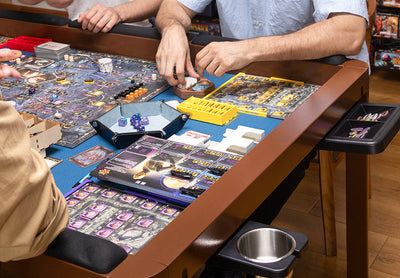
A recessed vault can make a board game table feel cleaner, safer, and easier to use. However, the depth of the recessed vault is more important than most people realize. A recess that is too shallow will mean that larger player boards and taller miniatures will not fit in the recess, while a recess that is too deep will make it difficult to reach for cards, tokens and other pieces that are stored in the play area on top of the recessed play surface. The optimal depth of a recessed vault is largely dependent on the components that are to be stored in the recessed play area, and not just on the size of the table’s surface.
Table of Contents
- Why Vault Depth Changes the Feel of a Table
- Typical Vault Depth Ranges
- Card Games and Euro Games Usually Need Moderate Depth
- Miniatures and Taller Components Need More Vertical Clearance
- Player Boards Change the Real Requirement
- What Depth Is Actually Trying to Solve
- A Better Question Than “Is a Vault Worth It?”
Why Vault Depth Changes the Feel of a Table
Most people think of the depth of a vault in a table in terms of containing items that would otherwise roll off of the edge of the board game table. Dice, cards, tokens and other items are kept in the recessed area of the play surface to prevent them from getting lost. But the depth of a vault also affects the hand angle with which one reaches across the surface of the table, as well as the sightlines that one has to the various parts of the game board. Perhaps most importantly, a recessed vault also keeps players from dragging all of their stuff to the center of the table. The best table is one that allows each player to manage their space in a natural, comfortable fashion while seated at the table.

Typical Vault Depth Ranges
If you want a faster buying reference, a shallow vault usually fits card-focused games and lower-profile components best. A moderate vault works for most general board game use, especially when player boards, token pools, and unfinished games need a little more protection. A deeper vault makes more sense when the table regularly hosts taller miniatures, layered terrain, or thicker dashboards.
In practical terms, many players can think of vault depth in three bands: around 1.5 to 2 inches for flatter card-first setups, around 2.25 to 3 inches for broad all-purpose board gaming, and 3 inches or more when vertical clearance becomes part of normal play. These are not hard rules, but they are useful anchors when comparing tables.

Card Games and Euro Games Usually Need Moderate Depth
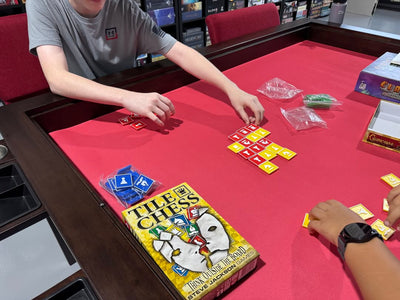
For card-heavy games, tableau builders, and most Euro games, moderate depth usually works best. You want enough drop to keep components contained and protect unfinished setups under toppers, but not so much that players are constantly reaching downward to pick up cards or move resources. These games often rely on repeated hand movement, so the vault should support easy access first and containment second.
This is also where a soft surface helps. Pairing the vault with proper playmats makes card pickup easier and reduces the feeling that components are sitting at the bottom of a box.
Miniatures and Taller Components Need More Vertical Clearance
Miniatures games, standing terrain, and chunkier player aids create a different problem. Here, the question is not only reach. It is a clearance. A vault that feels fine for flat cards may start feeling cramped once taller pieces, dashboards, or layered terrain enter the space. That is why miniature-heavy groups often care more about whether the vault can handle vertical variety without making the play area feel visually compressed.
A flexible gaming table should handle both flatter component games and more dimensional setups without forcing players into awkward workarounds.

Player Boards Change the Real Requirement
Player boards are one of the easiest ways to misjudge vault depth. Many people think only about the shared center, but long sessions often expand outward. Boards, mats, trays, and personal resource piles create thicker station layers than people expect. A vault that works for a simple family game may feel undersized once each player adds an individual board plus side components.
That is one reason BoxKing’s recessed-table logic works better when it is evaluated as play-space design, not as a generic furniture feature. The goal is to create a protected active area that still supports real table behavior.
What Depth Is Actually Trying to Solve
The right answer is not “deepest possible.” It is “deep enough for your real play mix.” If your group mostly plays cards, tokens, and flat boards, overly deep construction can add friction without adding much value. If your table regularly hosts minis, terrain, or thicker player setups, a shallow vault can become the limiting factor.
BoxKing’s product pages already frame the recessed game vault as part of the table’s functional identity. That is the right angle. Vault depth is not a cosmetic detail. It changes containment, comfort, and how much variety a table can handle before the play area starts feeling compromised.
A Better Question Than “Is a Vault Worth It?”
The smarter question is whether the vault depth matches the way your group actually plays. If the answer is yes, the table feels calmer, more usable, and easier to preserve between sessions. If the answer is no, even a premium table can feel like it is slightly working against the game. That is why vault depth deserves its own buying conversation instead of being buried under generic size advice.