How to Build Better Player Stations for 6-Player Board Game Nights
Six-player game nights usually break down for one simple reason: every player needs a usable personal zone, not just a seat at the table. Once six people are sharing cards, player boards, tokens, drinks, and shared resources, even a large surface can feel crowded if the layout is not planned. A better setup gives each player enough space to think, manage components, and stay comfortable for the full session.
Table of Contents
How Much Space Does Each Board Game Player Need?
A practical rule of thumb is to plan player stations by game type, not by table size alone. Lighter family games usually work with about 18 to 20 inches of width per player because each person is holding fewer components. Most Euro games feel better at roughly 22 to 24 inches per player, since player boards, resource pools, and card rows take more room. Campaign games often need around 24 to 28 inches because each station grows over time. Miniatures-heavy games can easily push beyond 30 inches per player once movement tools, trays, and side materials enter the picture.

But remember that width is only half the answer: there’s also the depth of the playing surface. A player may have enough side-to-side space available, but if everything (cards, tokens, players’ drinks) ends up sitting on a very narrow strip, then the station still doesn’t feel stable.
| Game Type | Recommended Width Per Player | Common Station Needs |
|---|---|---|
| Family Games | 18–20 in | Cards, score sheets |
| Euro Games | 22–24 in | Player boards, resources |
| Campaign Games | 24–28 in | Persistent components |
| Miniatures Games | 30+ in | Trays, rulers, unit cards |
A Simple 6-Player Board Game Table Setup
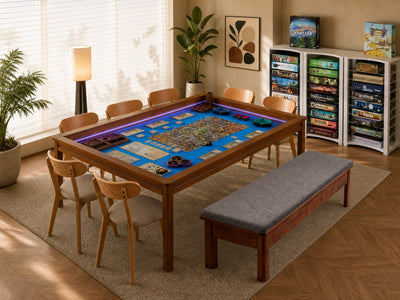
A clean 6 player board game table setup usually works best when the table is divided into three zones. The center zone should hold the board, market, map, or shared resource pool. The player zone should stay directly in front of each seat and hold the player board, hand area, active resources, and any reference cards. The outer zone should absorb everything that does not need to sit in the main play lane, especially drinks, spare components, and accessories.
This structure matters because six-player games create constant reach pressure. If personal items spill into the center, shared information becomes harder to read. If shared materials drift outward, players start reaching across each other. Good player stations keep those roles separated.

Typical Player Station Requirements
For a quick planning benchmark, most card games need enough room for a hand area plus one small active row. Euro games usually need a wider rectangle for a player board, tokens, and short card columns. Campaign games need extra width because items remain in play longer and tend to spread across the session. Miniatures games need the most buffer because tools, dice, unit cards, and spare tokens rarely stay compact for long.
That is why “more players need more room” is too vague to be useful. What really matters is matching the station to the workload at each seat.
Use Accessories to Protect the Player Zone
The fastest way to improve player stations is to move non-play items off the main surface. Cup holders keep drinks from invading card space. Card holders help players manage active cards without widening the station too much. Token trays stop resources and counters from spreading into neighboring areas, while side shelves create a better home for overflow pieces and personal tools.
Groups also benefit from BoxKing’s guide board game table size for your room through the lens of player stations, not just furniture fit. The same goes for best chairs for board game tables, because a station that looks organized on paper can still fail if players are cramped or constantly shifting posture.

Better Player Stations Make Multiplayer Games Feel Easier
The best six-player setups feel calmer, not just larger. Shared information stays readable. Personal items stay inside each player’s lane. Turns move faster because fewer objects need to be relocated between decisions. That is the real goal of better player stations for board games: not simply fitting six people around a table, but giving all six players enough space to actually play well.