How to Store Board Games: 9 Practical Tips for Every Collection
What is the best way to store board games? Store board games in a clean, dry location away from direct sunlight, organize loose components inside each box, and use shelves that allow games to be removed without moving several other boxes.
Horizontal storage works well for games with loose components or open inserts, while vertical storage can make individual games easier to retrieve when their contents are securely organized.
Whether you own ten family games or an entire wall of strategy games, the right board game storage system should protect your collection, simplify setup, and make your favorite games easy to access.

This guide covers practical board game storage ideas, including how to choose between horizontal and vertical storage, organize game pieces, measure shelving, protect game boxes, and make room for a growing collection.
How to Store Board Games: Quick Guide
| Storage Need | Recommended Approach |
|---|---|
| Frequently played games | Accessible shelves with minimal stacking. |
| Games with loose components | Horizontal storage or secured internal organizers. |
| Large board game collections | Adjustable or modular shelving that accommodates different box sizes. |
| Small spaces | Vertical shelving, compact storage units, and dedicated locations for small games. |
| Cards and game pieces | Labeled bags, lidded trays, card sleeves, and compatible inserts. |
| Long-term storage | A clean, dry, stable environment away from sunlight and potential leaks. |
Table of Contents
- Measure and Sort Your Board Game Collection
- Horizontal vs. Vertical Board Game Storage
- Choose the Right Board Game Storage Shelves
- Organize Board Game Pieces and Components
- Protect Cards, Boards, and Rulebooks
- Use Board Game Inserts and Organizers
- Store Small Games and Expansions
- Protect Board Games from Moisture and Damage
- Plan Storage for a Growing Collection
- Board Game Storage Checklist
- Frequently Asked Questions
1. Measure and Sort Your Board Game Collection
Before purchasing board game shelves, cabinets, or organizers, take stock of the games you actually need to store.
The best board game storage system is not necessarily the one that holds the most boxes. It is the one that fits your collection and makes your games easy to use.
Sort Board Games by Size and Playing Frequency
| Game Category | Storage Recommendation |
|---|---|
| Frequently played games | Keep at a comfortable, easily accessible height. |
| Large and heavy games | Use appropriately rated lower shelves with enough depth and support. |
| Small card games | Group together in a labeled basket, drawer, or shelf compartment. |
| Games with expansions | Keep expansions together or clearly identify their separate storage locations. |
| Occasionally played games | Use less accessible shelf space while keeping the boxes visible. |
| Collector's editions | Avoid unnecessary stacking pressure, sunlight, and moisture. |
Measure Your Largest Board Game Boxes
Measure the length, width, and thickness of your largest game boxes before choosing storage furniture.
If you plan to store games vertically, consider the height and depth of the box when standing upright. If you plan to store games horizontally, consider its flat footprint and thickness.
Important: Always compare game box measurements with the usable interior dimensions of a shelf, not just the overall furniture dimensions.
Leave enough room to grip and remove each box without scraping its edges or moving other games.
2. Horizontal vs. Vertical Board Game Storage
Should board games be stored vertically or horizontally? Both methods can work well. The right choice depends on the strength of the box, the organization of its contents, and how frequently you play the game.
Horizontal Board Game Storage
Best for:
- Games with loose components.
- Games with open internal trays.
- Boxes that need to remain flat.
- Games with delicate internal arrangements.
Keep stacks manageable and avoid placing excessive weight on fragile boxes.
Vertical Board Game Storage
Best for:
- Games with secured components.
- Collections with frequent game rotation.
- Boxes that remain closed when upright.
- Shelves designed for side-by-side access.
Check that cards, tokens, and miniatures remain secure when the box is tilted.
Illustrative comparison of horizontal and vertical board game storage.
Board Game Storage Orientation Comparison
| Storage Method | Advantages | Potential Drawbacks |
|---|---|---|
| Horizontal stacking | Helps loose components remain flat. | Lower games may be difficult to remove, and heavy stacks can compress boxes. |
| Vertical storage | Individual games can be easier to retrieve. | Components may shift and lids may open if the contents are not secured. |
| Individual shelf placement | Games can be accessed without lifting other boxes. | Requires suitable shelf spacing and compatible box dimensions. |
How to Store Board Games Vertically Without Mixing Pieces
- Place loose tokens and small pieces in resealable bags or closed compartments.
- Secure cards so they cannot slide into other sections of the box.
- Check that inserts and trays hold components in place.
- Close the box fully without forcing the lid.
- Support the lid and gently tilt the box before placing it upright.
If components move around significantly, improve the internal organization or continue storing the game horizontally.
3. Choose the Right Board Game Storage Shelves
Choosing the right board game storage shelves involves more than finding enough space for your collection.
Consider usable shelf dimensions, shelf spacing, load capacity, box accessibility, and whether the furniture can adapt as your collection grows.
How to Measure Shelves for Board Game Boxes
Start with the external dimensions of your game boxes and compare them with the usable interior space of each shelf.
Example Board Game Shelf Measurement
Assume a game box measures 12 × 12 × 3 inches.
| Measurement | Horizontal Storage | Vertical Storage |
|---|---|---|
| Box width on shelf | 12 inches | 3 inches |
| Box depth on shelf | 12 inches | 12 inches |
| Box height | 3 inches | 12 inches |
Add clearance for handling the box and any shelf frames or other obstructions.
For example, a 13-inch usable shelf depth would provide approximately one inch of additional depth for this example box.
Conceptual shelf measurement diagram, not a specific product specification.
Cube Shelving
Cube shelving provides separate compartments for board games and can create a consistent appearance in shared living spaces.
However, fixed openings may limit the arrangement of oversized boxes. Measure the usable dimensions of each compartment before choosing this type of furniture.

Adjustable and Modular Board Game Shelving
Adjustable shelving is useful when your collection includes different box heights, oversized games, expansions, and accessories.
A flexible shelf arrangement allows you to change the available space instead of forcing every game into a fixed compartment.
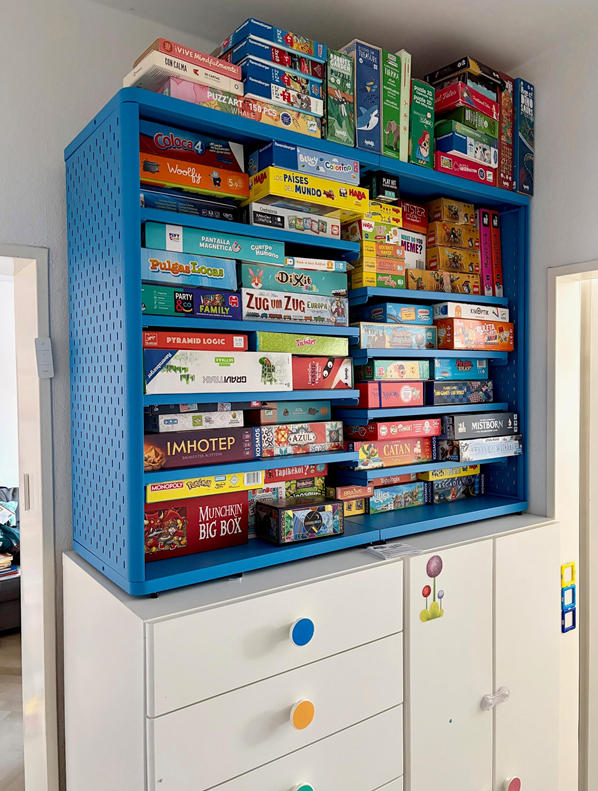
Explore the GameKeep modular board game storage shelf if you need a shelving arrangement that can accommodate changing storage requirements.
Dedicated Board Game Storage
Dedicated board game storage is worth considering when individual game access and collection display are important.
Instead of placing many heavy boxes in one stack, a suitable shelf arrangement can provide separate locations for games that you frequently retrieve.

Compare dedicated board game shelving options based on your collection size, available wall space, box dimensions, and preferred storage orientation.
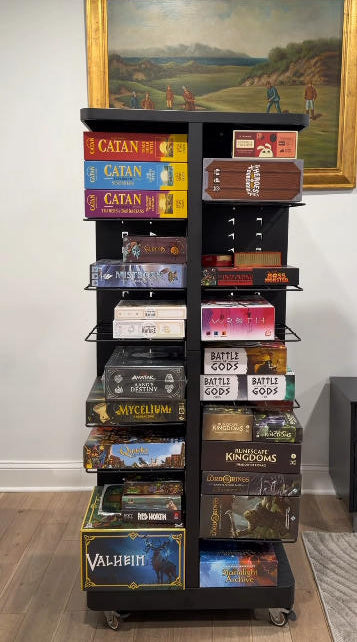
Rolling Board Game Storage Racks
A rolling storage rack can serve as a game-night station for frequently played games, accessories, and shared resources.
Check its load capacity, keep heavy items lower in the arrangement, and use caster locks when parked if the product includes them.
Which Board Game Storage System Should You Choose?
| Storage Need | Suggested Solution | Why Consider It? |
|---|---|---|
| Large, mixed-size collection | GameKeep modular shelving | Adjustable shelf arrangements for different box dimensions. |
| Individual game access | Dedicated board game shelves | Helps reduce unnecessary stacking and game retrieval effort. |
| Frequently used games | Rolling storage rack | Provides a mobile storage option near the gaming area. |
| Tabletop gaming accessories | GamePillar tabletop game organizer | An option for organizing frequently used gaming items. Check its available configurations and dimensions. |
| Small card games | Labeled baskets or drawers | Prevents smaller games from disappearing behind larger boxes. |
Find Storage That Fits Your Board Game Collection
Compare modular shelving, dedicated board game storage, and flexible organizers to find a solution that fits your collection and available space.
Explore Board Game Storage Solutions4. Organize Board Game Pieces and Components
Good board game organization begins inside each box. Keeping cards, tokens, dice, miniatures, and player components separated can reduce setup time and make packing away easier.
Instead of sorting every component only by type, consider organizing pieces around how they are used during gameplay.
Create Individual Player Kits
If each player begins with colored pieces, several tokens, and a reference card, store those items together as a player kit.
At the beginning of a game, each player can take one bag or tray instead of collecting pieces from several locations.
Use Resealable Bags for Small Game Pieces
Resealable bags are a simple and inexpensive option for organizing dice, wooden pieces, tokens, and other small components.
- Separate components by player, resource, or gameplay function.
- Label bags for games that are played less often.
- Avoid overfilling bags or creating pressure against the game board.
- Check that the box closes properly.

Use Lidded Trays for Shared Resources
Compartment trays keep different resources separated. Trays that move directly from the box to the table can also reduce the need to sort pieces before each session.
Check that compartments are deep enough and that lids fit securely. Small tokens can move between compartments if there is a gap between the lid and dividers.

Board Game Component Storage Guide
| Component | Storage Method |
|---|---|
| Dice and tokens | Resealable bags or lidded trays. |
| Player pieces | Individual player kits. |
| Cards | Suitable card compartments, dividers, or deck boxes. |
| Miniatures | Protective compartments or compatible miniature storage. |
| Expansion components | Labeled sections or separate identified containers. |
| Rulebooks and player aids | Flat storage away from loose components that could crease them. |
5. Protect Cards, Boards, and Rulebooks
Board game storage should protect the contents of each box as well as the box itself.
Protect Frequently Used Cards
Card sleeves can help protect cards that are frequently shuffled or handled. They may also be useful when replacement cards are difficult to obtain.
Before purchasing card sleeves, check:
- The exact dimensions of the cards.
- The number of cards you need to sleeve.
- Whether the original insert accommodates sleeved cards.
- Compatibility with deck holders and other accessories.
Remember: Card sleeves add thickness. A deck that fits neatly into its original compartment may require more space after sleeving.
Store Game Boards Flat Inside the Box
Fold boards along their intended folds and avoid placing heavy or irregularly shaped components directly against them.
Store rulebooks and reference sheets flat where possible. Do not force a lid closed over an overcrowded box, as this may damage cards, boards, and other contents.
Protect Board Game Box Corners and Lids
Avoid excessive stacking pressure and shelves that are too narrow for the boxes. Repeatedly pulling a tightly fitted game from a shelf can wear its edges and corners.
Leave enough handling space around frequently used games and support larger, heavier boxes when removing them.
6. Use Board Game Inserts and Organizers When Needed
Not every board game requires a custom insert. For games with relatively few components, labeled bags or simple trays may provide sufficient organization.
Consider upgrading your internal storage when you repeatedly encounter problems such as:
- Spending too much time sorting components.
- Finding pieces mixed together after moving a box.
- Running out of space after sleeving cards.
- Forgetting expansion components stored separately.
- Being unable to store a game vertically without its contents shifting.
Custom Inserts and 3D-Printed Organizers
A compatible board game insert gives components defined locations. Some removable trays can also serve as resource holders during gameplay.


Before buying or printing a custom insert, confirm the following:
- The game edition and supported box dimensions.
- Which expansions are compatible.
- Whether sleeved cards fit.
- Whether the box lid closes fully.
- Whether the arrangement works for vertical storage or travel.
Different editions of the same board game may have different box dimensions and components. A matching game title alone does not guarantee insert compatibility.
DIY Board Game Storage Dividers
Cardboard or foam-board dividers can be practical for simple internal storage layouts.
Measure and test the arrangement before final assembly. Allow adhesive to dry completely and keep glue away from game cards, boards, and other components.

The goal is to give pieces a reliable home while keeping them easy to remove. You do not need to fill every inch of the box.
7. Store Small Board Games and Expansions Efficiently
Small card games, travel games, accessory packs, and expansions can easily disappear behind larger boxes.
Give these items a permanent location instead of placing them wherever there happens to be an empty space.
Group Small Games Together
Use a dedicated basket, drawer, or shelf compartment for small games. Leave enough room to browse the collection without removing everything.
For a shared household collection, categories such as family games, two-player games, party games, and quick games may be more useful than alphabetical organization.

Should You Combine Board Game Expansions?
Combining expansion components into the base game box can save shelf space when the contents fit without pressure or overcrowding.
However, keeping expansions separate may be more practical when they contain large boards, many additional cards, or components used only in specific scenarios.
If an expansion is stored separately, place a location note inside the base game box so you can find it easily.
How to Store Board Games in Small Spaces
When floor space is limited, make better use of existing shelf height and avoid unnecessary duplicate storage furniture.
- Use adjustable shelf spacing where available.
- Keep small games in dedicated containers.
- Store suitable games vertically.
- Use lower-access storage for occasionally played games.
- Consider under-bed storage in a clean, dry location for less frequently used games.
- Keep shelves stable and follow manufacturer installation and anchoring instructions.
If you are organizing both your board game collection and surrounding furniture, read our small game room storage guide for additional space-saving ideas.
8. Protect Board Games from Moisture, Sunlight, and Damage
The storage environment can affect the condition of cardboard boxes, paper cards, game boards, and other components over time.
Choose a clean, dry indoor location away from direct sunlight, potential leaks, and large changes in temperature or humidity.
| Storage Risk | Potential Problem | Prevention |
|---|---|---|
| Moisture | Warped cardboard, damaged paper, or mold growth. | Store in a dry environment and address persistent moisture problems. |
| Direct sunlight | Fading of box artwork and printed materials. | Keep games away from prolonged direct sun exposure. |
| Excessive stacking | Compressed lids or damaged box corners. | Reduce heavy stacks and use appropriately supported shelving. |
| Dust | Dirty boxes and storage surfaces. | Clean shelves regularly or use suitable enclosed storage. |
| Loose components | Mixed pieces or damaged delicate items. | Use secure internal organizers. |
Can You Store Board Games in a Garage or Basement?
A garage, basement, or attic may be suitable only if its conditions remain appropriate for the materials in your games.
Check for moisture, leaks, pests, and significant temperature changes before using these areas for long-term storage.
Avoid placing valuable games directly on floors where they could be exposed to water or damp conditions.
If the room has a persistent moisture problem, address the environment rather than relying only on small desiccant packets.
How to Store Board Games with Miniatures
Painted miniatures and delicate figures require protection from collisions, pressure, and unnecessary movement.
Small protruding parts such as wings, weapons, and decorative details should not support the weight of other pieces.

Use suitable protective compartments or compatible miniature organizers, and test the arrangement before moving or transporting the game.
9. Plan Board Game Storage for a Growing Collection
When every shelf is completely filled, even a neatly organized board game collection can become difficult to use.
New games, expansions, and changes in playing habits can quickly create storage problems if there is no room to adjust the arrangement.
Leave Space for Future Board Games
As a practical planning example, you might reserve approximately 10–20% of your available storage capacity for future additions if space allows.
This is an optional planning allowance, not a required storage standard. The right amount depends on how quickly your collection grows.
Example Collection Growth Plan
Assume you currently own 80 games and want to reserve 20% of your planned storage capacity for future additions.
Estimated capacity = 80 ÷ 0.8 = 100 games
This would provide an illustrative allowance for approximately 20 additional games of comparable size.
Actual shelf capacity must be calculated from box dimensions, shelf spacing, load limits, and storage orientation.
Review Your Collection Occasionally
When adding a new game, review the shelf arrangement instead of squeezing the box into the nearest available opening.
Some rarely played games deserve a permanent place because of their sentimental or collecting value. Others may be suitable for trading, selling, or donating.
The goal is not to reduce your collection to a specific number of games. It is to create a storage system that helps you enjoy the games you own.
Explore modular board game storage systems if you need a shelving arrangement that can adapt to future collection changes.
Board Game Storage Checklist
Before reorganizing your board game collection or purchasing new shelves, use this checklist to identify the most important storage requirements.
- Measure your largest and heaviest board game boxes.
- Check the usable interior dimensions of shelves.
- Confirm shelf load limits and installation requirements.
- Separate frequently played and occasionally played games.
- Choose horizontal or vertical storage for each game.
- Secure loose cards, tokens, dice, and miniatures.
- Check that game box lids close properly.
- Reduce excessive stacking pressure.
- Assign dedicated locations to small games and expansions.
- Keep the collection away from moisture and direct sunlight.
- Leave enough room to remove individual games.
- Reserve additional storage space if your collection is growing.
Frequently Asked Questions About Board Game Storage
What is the best way to store board games?
Store board games in a clean, dry environment using shelves that fit their box dimensions. Organize loose components inside each box, avoid excessive stacking, and keep frequently played games easy to access.
Is it better to store board games vertically or horizontally?
Horizontal storage is often suitable for games with loose components or open inserts. Vertical storage can make individual games easier to retrieve when cards, tokens, and other pieces are securely organized. Choose the orientation that works best for each game.
How do you keep board game pieces from moving during vertical storage?
Use resealable bags, lidded trays, compatible inserts, and secure card compartments. Check that the lid closes properly and gently tilt the box before storing it upright.
How deep should board game storage shelves be?
Shelf depth should be based on the actual dimensions of your game boxes. For example, a box that is 12 inches deep requires at least that much usable shelf depth, plus any handling clearance needed for your preferred arrangement. Oversized games may require deeper shelves.
How do you store a large board game collection?
Sort games by size and playing frequency, use appropriately rated shelving, and consider adjustable or modular storage for different box dimensions. Keep heavier games on suitable lower shelves and reserve space for future additions.
How do you store board games in a small apartment?
Make use of available vertical space, group small games in dedicated containers, and choose shelving with suitable compartment dimensions. Less frequently played games can be stored in clean, dry under-bed storage when appropriate.
Is it safe to stack board game boxes?
Moderate stacking can work when boxes are structurally suitable and the shelf supports the total weight. Avoid placing excessive weight on fragile boxes and reduce stacks that make individual games difficult to retrieve.
How do you protect board games from humidity?
Store games in a clean, dry indoor environment away from leaks and persistent moisture. Avoid damp floors and inspect stored games periodically. Address underlying moisture problems rather than relying only on small moisture absorbers.
Should I keep board game expansions in the original boxes?
Keep expansions in their original boxes when they contain large or delicate components, or when combining them would overcrowd the base game. Combining compatible components can save space when everything fits safely and remains easy to identify.
Are modular shelves good for board game storage?
Modular shelves can be useful for collections with different box sizes or changing storage requirements. Check usable shelf dimensions, adjustment options, load capacity, and installation requirements before selecting a system.
Make Your Board Game Collection Easier to Use
The best way to store board games is to create a system that protects your collection while making games easy to find, retrieve, and return.
Start with the problem that most often gets in the way of playing.
- If setup takes too long, organize components into player kits and resource trays.
- If games are difficult to retrieve, improve shelf spacing and reduce stacking.
- If your collection is growing, consider adjustable or modular storage.
- If boxes are overcrowded, review inserts and component organization.
Small improvements inside each game box and across your shelves can make the entire collection easier to enjoy.
BoxKing offers board game storage systems for different collection sizes, storage preferences, and available spaces.
Build a Better Home for Your Board Game Collection
Explore dedicated board game shelves, modular storage systems, and practical organizers designed to help you keep your games accessible and ready to play.
Explore BoxKing Storage Options