Why We Make Gaming Tables, Storage Shelves, and KALLAX Shelf Inserts
At BoxKing, we make gaming tables, board game storage shelves, and shelf inserts for KALLAX units.
At first glance, these might look like different ways to sell more storage. But they exist for different reasons. A player who struggles to pull one game out of a crowded cube does not necessarily need a new shelving system. A collector whose boxes have outgrown the furniture will not solve that problem with another organizer. And someone who has to dismantle an unfinished campaign every evening may already have perfectly good shelves.
All three might describe their situation the same way: “I have nowhere to put my games.”
That sentence tells us something is wrong. It does not tell us which product would help.
This is the distinction behind our three product categories. We do not think every player needs all three. We think players should be able to understand what each one solves before deciding whether they need any of them.
Table of Contents
- The Storage Conversation Often Starts Inside the Box
- Problem One: The Games Fit, but Getting Them Out Is a Chore
- Problem Two: The Collection Has Outgrown the Furniture
- Problem Three: The Game Fits on the Table, but It Cannot Stay There
- These Are Different Problems, Not Levels Every Player Must Progress Through
- Why Buying More Storage Can Leave the Original Problem Untouched
- Why We Make All Three
The Storage Conversation Often Starts Inside the Box
When board gamers talk about storage, the conversation often turns to components.
Cards need dividers. Tokens need trays. Miniatures need protection. Sleeved decks take up more room than expected. An expansion introduces pieces that have no obvious place in the original insert.
These are real problems, and internal organizers can solve them well. A player kit can make setup easier. A removable resource tray can go straight onto the table. A suitable insert can keep everything organized between sessions.
But an organized game box still has to fit into your home.
It still needs a place on the shelf. You still need to retrieve it. And once the game is spread across a table, the empty box cannot preserve the positions of everything you have just set up.
This is where our approach extends beyond organizing individual components. We look at what happens around the box: how it sits in existing furniture, how the collection occupies a room, and what happens when a game needs to stay in progress.
Those are three different design problems.
Problem One: The Games Fit, but Getting Them Out Is a Chore
Picture a shelving unit that still has enough capacity for the collection. The games are off the floor. The room looks reasonably tidy.
Then someone chooses the game at the bottom of a stack.
You move the boxes above it, find somewhere to put them, retrieve the chosen game, and rebuild the stack. At the end of the evening, you do the same thing in reverse.
Standing games upright can make individual boxes easier to reach. But whether that works well depends on how the contents are secured. Loose pieces may shift, and some boxes do not stay neatly closed in that orientation.
Here, the problem is access. The furniture has room, but its compartments do not necessarily give each game a convenient position.
Why We Make KALLAX Shelf Inserts
LAX RAX addresses the relationship between a game box and the cabinet around it.
The idea is to give games separate horizontal shelf positions within a compatible KALLAX compartment. Instead of treating the cube as one space for a stack, you divide it into individually accessible levels.
That lets the existing cabinet continue doing useful work while changing how the games are stored inside it.
The distinction matters: a KALLAX shelf insert is not an organizer that goes inside a board game box. It will not create room for another expansion deck inside that box. Its job is to make the boxed game easier to store and retrieve.
For a player who likes their existing cabinet and has enough overall capacity, that can be the right scale of solution.
There is no need to replace an entire piece of furniture just because the arrangement inside its compartments is frustrating.

Where This Solution Reaches Its Limit
Dividing a compartment can make its space more useful. It cannot change the cabinet’s outside dimensions or create unlimited capacity.
If every compartment is already occupied, larger games have nowhere suitable to go, and new boxes are gathering beside the furniture, the problem has moved beyond access.
You need to consider the collection as a whole.
Problem Two: The Collection Has Outgrown the Furniture
A board game collection rarely grows in perfectly matching units.
One new arrival is a thin card-game box. Another is a large campaign game. An expansion might fit inside its base game, occupy a separate box, or become part of a larger combined storage arrangement.
Furniture with repeated, fixed compartments asks all of those shapes to fit the same pattern.
Sometimes that works very well. Sometimes small boxes leave awkward gaps, large boxes do not fit comfortably, and related content ends up scattered wherever there is room.
At this point, organizing the components inside each box will not address the main difficulty. The question is how the furniture should accommodate the collection.
Why We Make Dedicated Storage Shelves
Our shelving category responds to that larger problem.
With a system such as GameKeep, the purpose of adjustable shelving and compatible expansion options is to give the collection a structure that can respond to different boxes and changing needs.
The practical value is in how that structure can be used.
A large game can have an appropriate space instead of being squeezed into the nearest available gap. Smaller boxes can be grouped together. Base games and expansions can stay in recognizable areas. When more capacity is needed, a supported extension can become part of the plan rather than an improvised pile beside the original furniture.
This is a different job from improving access within an existing KALLAX cube. One adapts a compartment you already own. The other changes the storage framework around the collection.
A Growing Collection Needs More Than a Game Count
“How many games does it hold?” is a useful starting question, but it cannot fully describe a shelving setup.
A collection of small card games and a collection of large campaign boxes can contain the same number of titles while requiring very different amounts of space.
That is why box sizes, usable shelf space, and the way you group your collection matter alongside capacity. Adjustable height helps accommodate different boxes, but it does not make every box fit every shelf. The appropriate configuration still depends on what you own.
Dedicated shelving also does not make a room limitless. Expanding storage requires available space. Its value is that you can plan how the furniture changes, rather than repeatedly reorganizing around a structure that no longer suits the collection.
Problem Three: The Game Fits on the Table, but It Cannot Stay There
The third problem can exist even when every box has a perfect home.
You have enough shelving. The components are organized. You can find and retrieve the game easily.
The difficulty begins when the session ends before the game does.
The map is laid out. Cards and tokens record the current situation. Players have arranged their personal areas. But the table is also needed for dinner, work, or another household activity.
Packing everything away restores the room. It also creates the task of rebuilding the game later.
A well-designed insert can make that packing process easier. It cannot preserve the complete layout once the pieces have been removed from the playing surface.
This is a problem of keeping an active game, rather than storing an inactive one.
Why We Make Gaming Tables
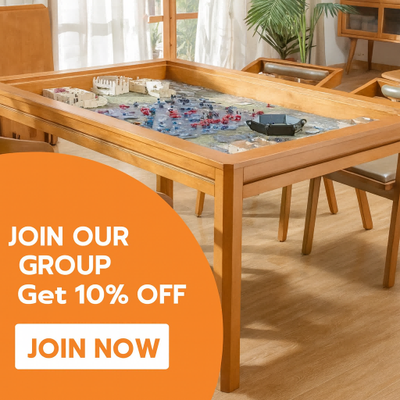
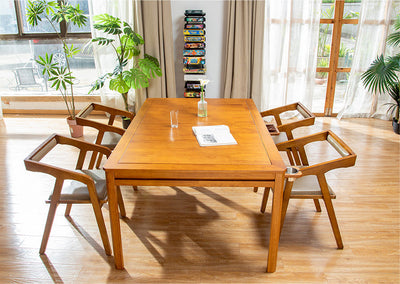
A recessed gaming table with a compatible topper provides a place for an unfinished session beneath an everyday surface.
For a suitable setup, the pieces can remain in the play area while the topper allows the table to serve another purpose. Returning to the game means uncovering the session rather than reconstructing it from its boxes.
That is one reason a table such as Kingswood belongs in a conversation about storage.
The table is holding something a shelf cannot: the arrangement of a game in progress.
The distinction is especially relevant in a shared room. A household may have space for one substantial table, but not for a second surface dedicated to a campaign that lasts several evenings.
In that situation, preserving play beneath a topper can make one piece of furniture serve both activities.
What a Gaming Table Does – and Does Not – Store
The game still has to fit within the available playing area and the clearance beneath the topper. Tall scenery, miniatures, or accessories may need to be removed. The appropriate topper and included items depend on the table and configuration.
A gaming table also does not replace the shelves holding the rest of the collection.
It provides a home for the active session. The other games, unused expansions, empty boxes, and spare supplies still need their own places.
For players who finish and pack away their games after every session, this feature may be less important. For players repeatedly pausing the same game, it can address a difficulty that additional shelving would leave untouched.
These Are Different Problems, Not Levels Every Player Must Progress Through
It would be easy to describe this as a buying ladder: start with shelf inserts, move to a storage system, and eventually buy a gaming table.
That would miss the point.
A player with a small collection might regularly play one long campaign and care deeply about preserving its setup. A collector with hundreds of shorter games might need substantial shelving but have little use for leaving a session assembled.
Someone else might be happy with their current furniture and simply want to retrieve a game without disturbing a stack.
The appropriate solution follows the way the games are used.
| What feels difficult? | What needs to change? | Relevant solution |
|---|---|---|
| Taking one game out of an otherwise usable cabinet | The arrangement inside the compartment | Compatible shelf inserts |
| Finding suitable homes for a growing mix of boxes | The collection’s storage structure | Dedicated shelving and appropriate expansions |
| Clearing the table without losing an unfinished setup | How the playing surface serves the household | A suitable recessed game table and topper |
You may recognize one row. You may recognize all three.
Either way, the useful starting point is the problem you experience most often – not the next product category in a sequence.
Why Buying More Storage Can Leave the Original Problem Untouched
A storage purchase can work exactly as designed and still fail to address the reason you bought it.
An internal organizer may make a game beautifully tidy while the box remains difficult to retrieve from the cabinet.
An additional shelf may give every box a home while an ongoing campaign still has to be dismantled before dinner.
A gaming table may preserve a session while the rest of the collection continues to overflow.
In each case, the product has improved one part of the system. The original frustration sits somewhere else.
Before deciding what to add, finish this sentence as specifically as possible:
“The part that makes storing or playing my games difficult is…”
If the answer is sorting loose components, work inside the box.
If the answer is moving other boxes to reach the one you want, look at access within the furniture.
If the answer is that the collection no longer fits, look at the storage structure and its capacity.
If the answer is packing away a game you want to continue, look at how the playing surface could preserve that session.
That distinction is more useful than treating every difficulty as a general need for “more storage.”
Why We Make All Three
We make KALLAX shelf inserts, dedicated storage shelves, and gaming tables because they operate at different scales.
One improves the space between a game box and an existing cabinet.
One gives the collection a structure suited to its changing contents.
One gives an unfinished game a place to remain in play while the room continues to serve everyday life.
These products can work together. They can also be useful independently. A player should not need to buy all three to benefit from one.
Our responsibility is to make those differences clear. When we explain a storage product, we should be able to explain which problem it addresses – and where its usefulness ends.
You can explore our storage systems and gaming tables with that distinction in mind.
The most useful purchase may be a small change to furniture you already own. It may be a different structure for your collection. It may be a way to leave tonight’s game ready for tomorrow.
The right answer starts with understanding what “no space” means in your home.