How to Turn Your Dining Room Into a Gaming Room
A dining room is one of the easiest rooms to turn into a gaming space because it already has the hard parts: a central table, chairs, overhead lighting, and enough room for people to gather together. The challenge is creating a setup that works for both meals and game nights without making the room feel permanently converted.
Table of Contents
Decide Whether Dining or Gaming Comes First
A dining room is one of the easiest rooms to turn into a gaming space because it already has the hard parts: a central table, chairs, overhead lighting, and enough room for people to gather together. The problem is that dining rooms are also shared rooms. They still need to look presentable, handle meals, and avoid becoming a permanent pile of games and accessories.
Start by looking at how the room is actually used. If the room hosts dinner a few times a month but game night happens every week, the room should be planned as a gaming-first dining room, not a dining-first room with board games squeezed into it. If meals happen daily, the setup needs a faster reset routine.

Map the Dining Room Into Four Zones
Instead of planning only around the table, divide the room into four zones. The table is the play zone. The chair path is the movement zone. A sideboard, cart, shelf, or cabinet becomes the staging zone. Closed storage becomes the reset zone.
This makes the dining room easier to use because every item has a job. Games and accessories should not all live on the tabletop. Rulebooks, sleeves, trays, card holders, and drinks need somewhere to go before and after play. If every item lands on the table, the room will feel messy even when the furniture is right.
Choose a Table That Can Switch Modes
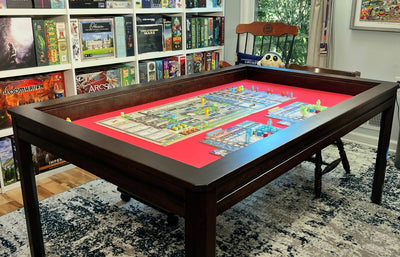
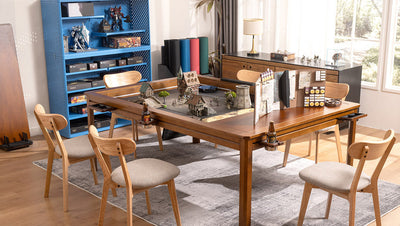
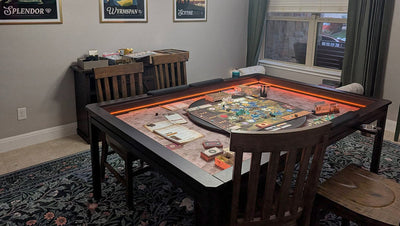
The table is the main decision. A regular dining table can work for casual games, but it struggles when a session needs a soft play surface, component control, drink safety, or a paused setup. A dining game table gives the room two modes: closed and clean for meals, open and ready for play.


A wooden gaming table is usually easier to blend into the room than a highly technical-looking setup, and a removable dining topper becomes important when the same surface has to handle dinner the next day. That matters most for campaign games, long RPG sessions, and groups that want to continue where they stopped instead of starting from zero every time.
Storage should stay close without becoming visually distracting. A shelf across the room looks tidy, but if players have to leave the table repeatedly for tokens, sleeves, playmats, or expansions, the flow of the session becomes interrupted. Keep active games and frequently used accessories in one nearby storage zone, and move larger collections or rarely used items elsewhere.
Keep Storage Close Without Making It Loud
Lighting is another underrated issue. Dining rooms often have a single decorative fixture that looks good but casts shadows across cards and boards. For game night, players need readable light across the whole surface. Add warm side lighting or adjustable lamps if the overhead light leaves the table uneven.
Seating decides whether the room is comfortable after several hours of play. Dining chairs that are fine for a meal may feel stiff during a four-hour game. If you use the room heavily, think about the game table and chairs as one setup: enough support, enough elbow room, and enough space to slide back without hitting shelves or walls.
Dining Room Conversion Priorities
| Dining-room issue | Planning check | Best conversion move |
|---|---|---|
| Room still hosts meals | Closed-table appearance and fast cleanup | Use a topper or clean closed mode so the room returns to dining use without a full reset. |
| Accessories drift onto the table | Active tools need a home near the play zone | Use a sideboard, cart, or cabinet for trays, sleeves, card holders, mats, and current games. |
| Overhead light creates shadows | Cards and boards must be readable from every seat | Keep the fixture for room style, then add side lighting or adjustable lamps for game night. |
| Players block the walkway | Chair path and serving path overlap | Keep one main movement lane clear; let the lowest-traffic side sit closer to a wall if needed. |
| Room looks too hobby-heavy | Visible collection and accessory noise | Show only attractive or active games; keep tools in closed storage so the room still feels finished. |
Make Comfort Last Past Dinner
Then plan the after-game state. Where does the current campaign box go if the group is not finished? Where do card holders, token trays, playmats, and cup holders live when the table closes? Board game storage furniture should answer those questions before the first session, because dining rooms fail as game rooms when cleanup depends on motivation. They work when reset has a fixed path.
The best dining-room gaming setup does not hide the fact that games happen there. It makes the room feel adult, organized, and ready for both uses. Keep the table convertible, keep accessories contained, and build a reset routine that takes minutes instead of becoming a second hobby.