How to Store Board Games: Organize Your Collection and Make Game Night Easier
Good board game storage does more than keep boxes looking neat. It helps you find the game you want, keep track of its components, and spend less time setting up and packing away.
Whether you own a few family favorites or an entire wall of strategy games, start with two things: organizing the pieces inside each box and finding a practical way to store the collection as a whole.

Table of Contents
- Know Your Collection Before Buying Storage
- Organize Components Around Setup
- Protect Cards Without Overcrowding the Box
- Upgrade Inserts When They Solve a Problem
- Choose Between Horizontal and Vertical Storage
- Choose Storage Furniture for Access as Well as Capacity
- Give Small Games and Expansions a Permanent Home
- Pay Attention to the Storage Environment
- Leave Room for Your Collection to Change
- Start With What Gets in the Way of Playing
1. Know Your Collection Before Buying Storage
Before purchasing shelves, cabinets, or organizers, take stock of what you need to store.
Group your games into a few useful categories:
- Frequently played games: Keep these visible and easy to reach.
- Large or unusually shaped boxes: Set aside enough space for their dimensions.
- Small card games: Store these together so they don’t disappear behind larger boxes.
- Games with expansions: Decide whether to combine components or keep them in separate, clearly labeled locations.
- Occasionally played favorites: Give these a home without using your most accessible shelf space.
Next, measure the length, width, and height of your largest boxes. Consider whether you’ll store them flat or upright.
When comparing storage furniture, check the usable interior dimensions rather than relying on the overall measurements. Leave enough clearance to grip and remove each box, and check the weight limit for each shelf.
A game that barely fits – and takes a struggle to pull out – isn’t stored conveniently.
2. Organize Components Around Setup
Sorting pieces by type is a helpful starting point. Organizing them around how you actually play can make setup even easier.
If each player starts with a set of colored pieces, several tokens, and a reference card, store those items together as a player kit. At the beginning of the game, everyone can take one bag or tray.
Keep shared resources together, and separate components used only in particular scenarios or expansions.
Resealable Bags: A Simple Starting Point
Resealable bags work well for dice, wooden pieces, tokens, and other small components.
Choose bags that hold their contents comfortably without leaving excessive room for movement. For games you play less often, label each bag so you won’t have to figure out its purpose next time.
Before closing the box, check that bulky bags aren’t pressing against the board or preventing the lid from sitting properly.

Lidded Trays: Storage That Goes Straight to the Table
Compartment trays keep different resources separated. If they can move directly from the box to the table, they can also save you from pouring out and sorting pieces before every session.
Check that compartments are deep enough and that lids fit securely. Small tokens can slip between sections when there’s a gap between the dividers and the lid.
If you plan to store the game upright or take it to a friend’s house, test whether the organizer keeps everything in place when tilted or moved.

3. Protect Cards Without Overcrowding the Box
Sleeves are an option for cards that are shuffled or handled frequently. They can also be useful when a replacement deck would be difficult to find.
Before buying sleeves, check:
- The exact card dimensions.
- How many cards you want to sleeve.
- Whether the original insert accommodates sleeved cards.
- Whether your deck holders and other accessories remain compatible.
Sleeves add bulk. A deck that fits neatly into its original compartment may no longer fit after sleeving, so plan card protection and box organization together.
For ordinary playing decks, prioritize protection that still lets you shuffle and handle the cards comfortably. Rigid holders are more appropriate for individual collectible or display cards than for every card in a board game.
Store rulebooks flat, away from loose components that could crease them. Fold boards along their intended folds, and avoid forcing a lid shut over an overfilled box.
4. Upgrade Inserts When They Solve a Problem
Not every game needs a custom insert. For a game with relatively few components, several labeled bags may be enough.
Consider upgrading when you repeatedly encounter problems such as:
- Spending too much time sorting components before each session.
- Finding pieces mixed together after moving the box.
- Running out of room after sleeving cards.
- Forgetting expansion components stored in separate boxes.
Custom Inserts and 3D-Printed Organizers
A suitable insert gives components defined spaces, and some trays can double as resource holders during play.
Before buying or printing one, confirm:
- The game edition and box dimensions it supports.
- Which expansions fit.
- Whether it accommodates sleeved cards.
- Whether the lid closes fully with everything inside.
- Whether it works for vertical storage or travel.
Different editions of the same game may have different boxes and components. A matching game title alone doesn’t guarantee compatibility.


DIY Dividers
For simple layouts, cardboard or foam-board dividers can be a practical option.
Measure and test the arrangement before final assembly. Let adhesive dry completely, and keep glue away from cards, boards, and other game components.
The goal is to give pieces a reliable home while keeping them easy to remove. You don’t need to fill every inch of the box.

5. Choose Between Horizontal and Vertical Storage
There’s no single correct orientation for every board game. The best choice depends on the box, the interior organization, and your shelving.
| Storage method | When it can work well | What to check |
|---|---|---|
| Horizontal storage | Games with open trays or components that need to stay flat | Stack height, pressure on lower boxes, and ease of removal |
| Vertical storage | Games with secured components and boxes suited to upright placement | Shifting pieces, loose cards, and lids sliding open |
| Individual shelf placement | Games you want to retrieve without moving other boxes | Shelf spacing, usable dimensions, and weight limits |
Before storing a game vertically, support the lid and gently tilt the box. If you hear components moving around, check the interior arrangement first.
For horizontal storage, keep stacks manageable. If reaching one game means lifting several others, consider reducing the stack or giving that game its own shelf space.
6. Choose Storage Furniture for Access as Well as Capacity
Storage capacity matters, but so does being able to use your collection comfortably.
Before choosing furniture, consider which games you play most often, how much your box sizes vary, and whether your storage belongs in a dedicated game room or a shared living space.
Cube Shelving
Cube shelving creates separate sections for your collection and can give a room a consistent look.
Check the interior dimensions of each opening before buying. Larger boxes may need a different location, while small games can sit together in labeled baskets.
Avoid filling baskets so tightly that finding one game requires emptying the whole container.

Adjustable Shelving
Adjustable shelving offers flexibility when your collection includes a variety of box sizes.
Look at the available shelf positions, usable depth, and the work involved in moving shelves. If you rearrange your collection frequently, ease of adjustment will affect how convenient the storage feels.
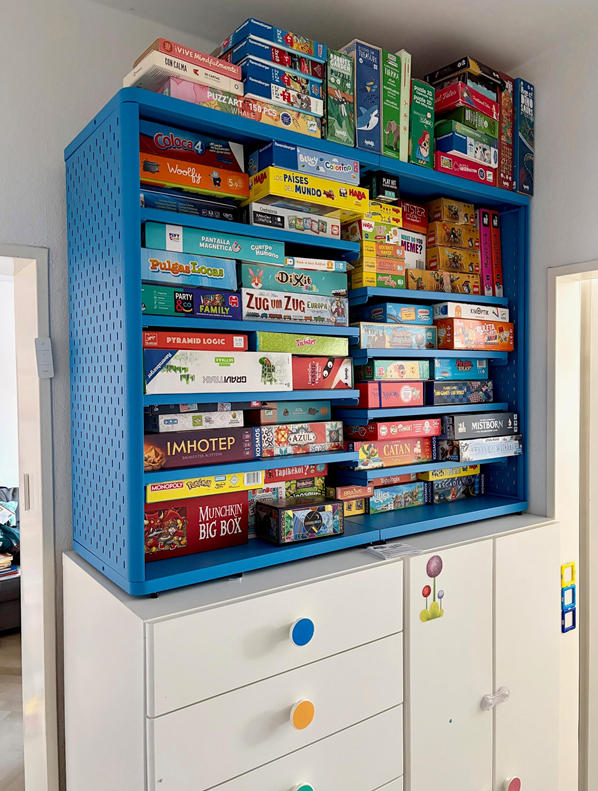
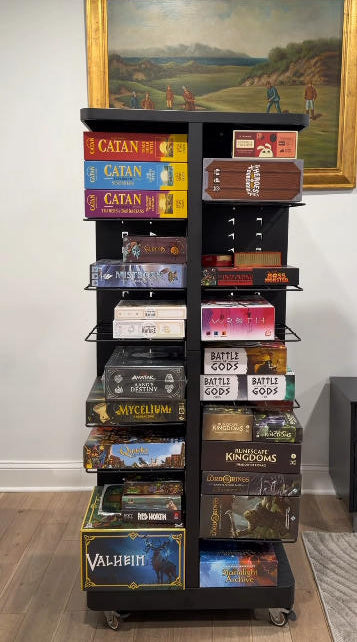
Dedicated Board Game Storage
If displaying your collection and retrieving games easily are priorities, consider storage designed specifically for board games.
Compare options against your box sizes, collection size, and preferred arrangement. Check the specifications of the exact configuration you’re considering rather than relying solely on display photos.

Rolling Carts and Under-Bed Storage
A rolling cart can serve as a game-night station for a few favorites or accessories. Check its load capacity, keep the arrangement stable, and lock the casters when parked if that feature is available.
Under-bed storage is better suited to games you don’t need to reach often. Include wheels and handles when measuring clearance, and choose a container that keeps dust out without squeezing the boxes.
7. Give Small Games and Expansions a Permanent Home
Small card games, travel games, and accessory packs can easily get lost among larger boxes.
Assign them a specific basket, drawer, or shelf section. Add labels where useful, and leave enough room to browse without unpacking everything.
If an expansion is stored separately, place a location note inside the base game’s box so you know where to find the remaining components.
Your collection doesn’t have to be arranged alphabetically. For a shared household collection, categories such as “family games,” “two-player games,” and “quick games” may make choosing something to play easier.
8. Pay Attention to the Storage Environment
Good storage should make regular cleaning and inspection straightforward.
Choose a clean, dry location away from direct sunlight, potential leaks, and large changes in temperature or humidity. Before storing games in a garage, attic, or basement, assess whether the conditions are suitable for long-term storage.
Dust shelves regularly and keep drinks away from stored boxes. If the room has a persistent moisture problem, address the environment rather than relying only on small desiccant packets.
For painted miniatures, focus on preventing collisions and pressure. Delicate parts such as weapons and wings shouldn’t carry the weight of other pieces.
9. Leave Room for Your Collection to Change
When every gap is filled, even a neatly organized collection can become difficult to use.
Where space allows, leave some room for expansions, new games, or layout changes. When adding a game, review the arrangement instead of squeezing the box into the nearest opening.
Occasionally revisit games you haven’t played in a while. Some deserve a permanent place because of their sentimental or collecting value. Others may be good candidates for trading, selling, or donating.
There’s no need to give every game a fixed deadline for being played. The purpose of organizing is to help you enjoy the collection you own.
Start With What Gets in the Way of Playing
If setup takes too long, begin with player kits and organized resource trays.
If games are difficult to retrieve, rethink your stacks and shelf spacing.
If boxes are overcrowded, review the inserts and component layout before purchasing more furniture.
Small improvements inside the box and across your shelves can make your collection easier to use. The best board game storage helps you keep things organized – and makes you want to take those games out and play.
Looking for storage that keeps your collection accessible and ready to display? Explore BoxKing’s board game storage options and choose a setup that fits your game boxes, available space, and playing habits.
Explore BoxKing Storage Options