
Wingspan, Wyrmspan, or Finspan: Where to Start?

If you’re wondering where to start with the Wingspan family of games, this guide compares Wingspan, Wyrmspan, and Finspan to help you decide which one best fits your taste, play style, and experience level.
Table of Contents
Back in 2019, a woman named Elizabeth Hargrave quickly became one of the world’s most prominent game designers with the release of Wingspan, an elegant engine builder inspired by her interest in birdwatching. Appealing to beginners and experts alike, the hit game combines strategic gameplay with a captivating theme and stunning art.
In the early years of modern tabletop games as we know them, players weren’t looking at this sort of strategy game for the stunning art—though there were already amazing artists involved. If you’ve been in this world for long enough, you might recall the divide between European-style (strategy) and American-style (luck and immersion) gamers. But Wingspan became one of the pillars of a new era. An example of what we can do with elements of both worlds, coming at a time when we were ready to embrace it.
It worked out so well that the game became a series, now spanning several regional expansions, a digital version, and two spin-offs—one with dragons and one with fish. Each new release is met with high expectations, because this is a case of warranted praise.
But for those new to the series, it’s more reason to wonder: where to start, what it’s all about, and which one is the best? Wingspan, Wyrmspan, or Finspan?
The answer, as always, is that it depends on your taste and style. But hopefully this will help you make a more informed decision.
Wingspan

Let’s start from the beginning.
Wingspan, designed by Elizabeth Hargrave and first published by Stonemaier Games in 2019, is a game where you collect bird cards and place them on your board to gain points and make your actions stronger. Bird cards represent actual species and are beautifully illustrated by Colombian artists Ana María Martínez and Natalia Rojas, while the player boards are designed by the great Beth Sobel. There are three main actions you can take, represented by habitats: gaining food to attract birds (forest), laying eggs to play more birds (grasslands), and drawing new cards (wetlands).
Each bird played on your board unlocks a more powerful level of that habitat’s action just by being there. But in addition to that, most of them also have powers of their own. Some are activated when played, while others come into effect at the end of each round, others are triggered by opponents’ actions, and several others are activated when their habitat is activated. These make your board even stronger.
Gameplay details like habitats, food, and nest types are all inspired by each bird’s actual features. And to make it even more fitting with the theme, powers are inspired by their behavior. Migratory birds, for instance, can move from one habitat to another. Predators hunt for smaller birds or food, with a helping hand from luck. Birds that create flocks stack other bird cards under them to gather more points. Each expansion introduces new birds native to a specific continent, which sometimes also means new mechanics.
And finally, an aspect of Wingspan that ties it all together beautifully is the production. The wooden dice are rolled in an included dice tower named (and visually inspired by a) birdfeeder. Wooden eggs come in various colors that make each board even more unique. And the elegance of leaving an action marker behind each round by placing it on the corresponding end-of-round goal? Simply unmatched.
Wyrmspan
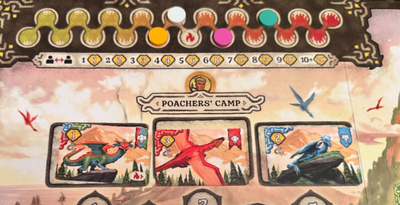
 Wyrmspan, designed by Connie Vogelmann (Apiary), illustrated by Clémentine Campardou, and developed in collaboration with Hargrave, is a dragon-themed spin-off meant for players looking for a more complex experience. Food is scarce, actions are now a variable resource, eggs are less of a scoring element and more of a resource, you have to excavate habitats before playing dragons there, and a new Guild board can be an excellent source of points. But hey, ties are friendly this time.
Habitats in this game are called caves, and activating them (an action now called “exploring”) costs more resources if you do it more than once in the same round. Food is harder to come by, but to be fair, you will also be using less of it. There is a lot more to do.
Instead of using the same components to count actions and score end-of-round goals, Wyrmspan goes for a different approach. Cubes are placed on central boards for end-of-round goals and Guild bonuses, and actions are now measured by metallic dragon coins—this gives the game freedom to use coins as a resource, allowing it to be earned elsewhere and used to pay for more powerful actions and dragons.
The engine building itself, which is the core of Wingspan, holds a less central role here. Some dragons do still strengthen your board, but others give you resources like food, cards, eggs, coins, or Guild points when played. You can even find several dragons with end-of-game scoring goals, making your personal scoring goals more flexible than the bonus cards do. Despite being daunting at first, the radical difference is evident by the last round, which allows you to do a lot more than lay eggs ad infinitum.
Finspan

And finally, Finspan is the younger sibling, designed by David Gordon (LEGO Monkey Palace) and Michael O’Connell, illustrated by Ana María Martínez, Catalina Martínez and Mesa Schumacher, and also developed in collaboration with Hargrave. This one is often regarded as the easiest in this family of games. The idea now is that you are divers getting to know the diversity of species in the shallow or deep seas.
I’m going to start off by saying I’m personally not a fan of the board layout and size. I see what they were trying to do, and aesthetically it is stunning, but it just takes up way too much space, especially when the fish cards must be on the table rather than our hands. Your table will feel much smaller in this game than Wingspan.
Finspan does seem like it’s meant to be a simpler, more straightforward game, and the graphic design does wonders for it. Less types of resources, less types of fish, all really easy to read and understand. Having the cards work as resources also opens up a lot of possibilities, especially because of the new “food chain” dynamic, which allows (and sometimes requires) you to play some fish cards on top of others.
Like in Wyrmspan, the engine building itself is less central, and all personal scoring goals are on your board, depending on the fish you choose to play. Only this time, there is no Guild to split up your attention, and the end-of-round goals are usually resources you would need to gather anyway to progress. It might feel confusing at first, but it’s easier to feel rewarded in this game.
Playing them all at once

Recently, my friends and I got together for “Span Day.” The goal was to play at least one match of Wingspan, Wyrmspan, and Finspan, all the same day, in release order, and share our thoughts on the experience. And the experience of playing each game was surprisingly different, and that’s coming from someone who had already played them all before.
I must say, if you have the same idea we did, I highly recommend following the release order as well. Here is why.
Both spin-offs were, of course, born from Wingspan. That one is the foundation. Starting from there, you have a lot less to learn and re-learn in the subsequent matches, so it makes sense from a cognitive load standpoint.
Complexity itself also plays a part in the experience. Wyrmspan is considerably more complex, but leaving Wingspan first works as a sort of warm-up. And yes, Finspan is objectively simpler, but one of the reasons we think so is because we are so familiar with Wingspan in the first place. Leaving it last, we get some rest from all the brain cells we fried at the final stretch of Wyrmspan. It’s almost a cozy game at this point.
As for favorites… again, it depends on your taste and style. If I have to pick one, my heart is still with the OG, because I feel like there is an elegance to Wingspan that the two spin-offs can never match. But do they really have to? In the end, having the three games out in the world is the real win.
Quick Comparison
| Game | Complexity | Best For | Theme |
|---|---|---|---|
| Wingspan | Medium | Most players, beginners to experienced gamers | Birds |
| Wyrmspan | Higher | Players looking for a more complex experience | Dragons |
| Finspan | Lower | Players who want a simpler, more straightforward game | Fish |
If you are completely new to the series, Wingspan is still the best starting point for most players. Wyrmspan is the best pick for those who want more complexity, while Finspan may appeal most to players looking for a lighter and more accessible entry.
FAQ
Which game should most players start with: Wingspan, Wyrmspan, or Finspan?
For most players, Wingspan is still the best starting point because it is the foundation of the series and balances elegance with accessibility.
Is Wyrmspan more complex than Wingspan?
Yes. Wyrmspan is designed for players looking for a more complex experience, with more systems and resource management to consider.
Is Finspan the easiest game in the series?
Finspan is often regarded as the easiest and most straightforward of the three, with fewer resource types and simpler graphic design.
What order should you play Wingspan, Wyrmspan, and Finspan?
If you plan to play all three, the release order—Wingspan, then Wyrmspan, then Finspan—works especially well.



Jéssica Gubert
