Board Game Table vs. Dining Table: Is a Dedicated Gaming Table Worth It?
Table of Contents
- Board Game Table vs. Dining Table: The Quick Comparison
- Dining Tables Make You Pack Up. Gaming Tables Can Let You Pause.
- A Dining Table Gives You a Surface. A Gaming Table Gives You a Play Area.
- Gaming Tables Handle Drinks and Accessories Differently
- Bigger Isn't Automatically Better
- Dining Tables Often Win on Simplicity
- Comfort Matters More Than Features
- So, Is a Board Game Table Actually Worth It?
- The Best Upgrade Might Not Be a New Table
- Final Verdict: Choose the Table That Solves Your Problem
- Frequently Asked Questions
For most board gamers, the first gaming table they ever own isn't a gaming table at all.
It's the dining table.
And for many players, that's perfectly fine.
Clear the plates, bring out a game, and you're ready to play. A good dining table can handle everything from Catan to Wingspan without needing a single gaming-specific feature.
But the equation starts to change when games get bigger, sessions get longer, and game nights happen more often.
Cards, tokens, player boards, miniatures, rulebooks, snacks, and drinks all compete for space. A campaign runs past midnight. Dinner needs the table before the game is finished.
That's when a dedicated board game table starts to make sense.
But is it actually worth buying one?
The answer depends less on how serious you are about board games and more on what problems your current table is creating.
Let's compare.
Board Game Table vs. Dining Table: The Quick Comparison
| Feature | Dining Table | Board Game Table |
|---|---|---|
| Everyday dining | Excellent | Excellent with a topper |
| Casual board games | Excellent | Excellent |
| Cost | Lower | Higher |
| Recessed play area | No | Usually |
| Leave a game set up | Difficult | Often possible |
| Gaming play surface | Add separately | Often built in |
| Cup holders | No | Often available |
| Gaming accessories | Limited | Often modular |
| Large/long games | Good | Excellent |
| Setup between sessions | Usually repeated | Can be preserved |
| Flexibility as normal furniture | Excellent | Depends on design |
The biggest advantage of a dining table is simple:
You probably already own one.
It's versatile, familiar, and perfectly capable of handling most board games.
A gaming table needs to justify its additional cost and complexity by solving problems a normal table doesn't.
For most players, those problems fall into a few specific categories.
1. Dining Tables Make You Pack Up. Gaming Tables Can Let You Pause.
This is arguably the biggest practical difference.
Imagine you're four hours into a campaign game.
The board is covered in cards and miniatures. Everyone has their own resources, equipment, tokens, and player boards carefully arranged.
You're not finished.
But you need the dining table back.
On a normal table, that usually means packing everything away.
With a recessed gaming table and removable topper, you may be able to leave the entire game in place, cover the gaming area, and use the surface above it as a dining table.
When you're ready to continue, remove the topper.
The game is still there.
For a 30-minute family game, this feature probably doesn't matter.
For Frosthaven, Twilight Imperium, campaign games, miniature games, RPGs, or anything else that can occupy a table for hours - or days - it can completely change how convenient the game is to play.
So ask yourself:
How often do you stop playing because you need the table back?
If the answer is “almost never,” your dining table has a major advantage: you're not paying for a feature you don't need.
If the answer is “constantly,” a gaming vault becomes much easier to justify.
2. A Dining Table Gives You a Surface. A Gaming Table Gives You a Play Area.
A normal dining table is designed around plates, glasses, serving dishes, and everyday use.
That usually means a hard, flat surface.
There's nothing inherently wrong with gaming on it. But dedicated gaming surfaces can improve some of the small interactions that happen hundreds of times during a game night.

Cards can be easier to pick up.
Dice can sound quieter.
Components are less likely to slide.
A recessed play area also creates a physical boundary around the game, helping keep dice and components contained.
Many gaming tables use felt, neoprene, speed cloth, or another padded surface for this reason.

Of course, there's a much cheaper alternative.
Put a gaming mat on your dining table.
For players whose main complaint is the hard tabletop surface, a good mat may solve most of the problem without requiring new furniture.
That's an important distinction.
If a $50–$100 accessory fixes your biggest frustration, you probably don't need to replace the entire table.
And if a playmat is the upgrade that makes the most sense for your setup, choosing the right one matters more than it might seem. We break some factors down in our guide, [How to Choose the Right Playmat for Your Board Game Table], so you can find a surface that fits both your table and the kinds of games you

3. Gaming Tables Handle Drinks and Accessories Differently
A glass sitting beside a board game doesn't look particularly dangerous.
Until someone knocks it over.
On a dining table, drinks, phones, dice trays, cards, snacks, and game components all compete for the same surface.
Gaming tables can move some of those objects outside the primary play area.
Cup holders are the obvious example.
But modular accessory rails can go much further, supporting things like:
- cup holders;
- dice trays;
- card holders;
- token trays;
- player stations;
- side shelves.
This becomes especially useful with games that already consume most of the available tabletop.
Instead of making the table itself larger, accessories can effectively move some player items beyond the edge of the main play area.
A dining table can accomplish some of this with standalone accessories.
The difference is integration.
With a gaming table, the accessories can become part of the table rather than additional objects sitting on it.

4. Bigger Isn't Automatically Better
This comparison is one area where gaming tables don't automatically win.
A huge gaming table sounds ideal until you can't reach the center.
Dining tables are usually designed around comfortable eating distances. Gaming tables have to balance that same comfort with enough space for large boards, player areas, and components.
Too narrow, and sprawling games don't fit.
Too wide, and players spend the evening standing up to move pieces.
There's also the room itself.
A table needs space for chairs and enough clearance for people to move around them. A gaming table that technically fits in the room can still make the room uncomfortable.
Before replacing a dining table, compare the actual playable area you have today with the playable area you're considering.
Don't upgrade simply because the new table is bigger.
Upgrade because the dimensions work better for the games and player counts you actually have.
5. Dining Tables Often Win on Simplicity
Gaming tables have more features.
That also means they can introduce more things to manage.
The clearest example is the topper.
A removable tabletop sounds perfect: play underneath, dine above.
But when you remove those panels for game night, they have to go somewhere.
Large wooden topper panels leaning against a wall aren't particularly convenient. They take up space, can be awkward to move, and may be more vulnerable to scratches or accidental damage.
This is where a dedicated tabletop or topper storage rack can make a convertible gaming table much easier to live with. Instead of finding a temporary place for the panels every game night, a storage rack gives them a designated spot where they can be kept upright, organized, and out of the play area.
[Explore our Tabletop Storage Rack] if you're looking for a simple way to keep removable table panels safely stored while your gaming table is in use.
The same principle applies to other gaming-table accessories. Cup holders, trays, player stations, and other add-ons still need somewhere to go when they're not attached to the table.
That's something a traditional dining table rarely asks you to think about.
So if you're considering a convertible gaming table, don't only imagine the ideal gaming setup. Think through the full routine:
Dining → remove topper → store topper → attach accessories → play → remove accessories → replace topper → dining.
A well-designed table—and a practical storage solution for its removable parts—can make that process feel effortless. A poorly planned setup can turn convenience into another chore.
6. Comfort Matters More Than Features
Gaming sessions can last much longer than meals.
That makes comfort especially important.
One detail that's easy to miss when shopping online is what happens underneath the table.
A recessed vault takes up vertical space. So can rails, support structures, storage systems, and other hardware.
If the underside becomes too thick, your knees may have less room than they would under a normal dining table.
This is one category where you shouldn't assume “gaming-specific” automatically means “more comfortable.”
Check:
- table height;
- clearance underneath;
- vault depth;
- chair height;
- table width;
- comfortable reach distance.
After four hours of gaming, good ergonomics will matter much more than an accessory you rarely use.
So, Is a Board Game Table Actually Worth It?
Here's the simplest way to decide.
Stick with your dining table if:
You mostly play shorter or lighter games.
You don't regularly leave games unfinished.
Your current table comfortably fits your usual games.
You play occasionally rather than several times a week.
You have limited room for large furniture.
And most importantly:
Your current table isn't causing problems.
There's no reason to solve a problem you don't have.
A dining table with a quality gaming mat may be all you ever need.
Consider a dedicated gaming table if:
You host game nights frequently.
You play long strategy games, campaign games, RPGs, or miniature games.
You regularly need to pause games between sessions.
Your games frequently compete with drinks and accessories for table space.
You want a dedicated play surface.
You would genuinely use modular accessories.
Or you want one piece of furniture to function as both your gaming table and dining table.
The more of these problems you recognize, the easier the investment becomes to justify.
The Best Upgrade Might Not Be a New Table
There's also a middle ground that's easy to overlook.
Before buying a dedicated gaming table, ask what you actually dislike about your current dining table.
If cards are difficult to pick up, buy a gaming mat.
If drinks make you nervous, add external cup holders or side tables.
If the table is slightly too small, reconsider how player boards and accessories are arranged.
If your chairs are uncomfortable, upgrading the chairs may improve game night more than upgrading the table.
But if the fundamental problem is that you can't preserve an unfinished game while still using the room normally, that's much harder to solve with accessories.
That's where a convertible gaming table becomes genuinely different from a dining table rather than simply a more specialized version of one.
Final Verdict: Choose the Table That Solves Your Problem
A dedicated board game table isn't automatically better than a dining table.
It's better at certain things.
A dining table wins on simplicity, versatility, and cost.
A gaming table wins when you need a space designed around long sessions, sprawling games, modular accessories, or the ability to pause a game without packing it away.
That's why the most useful question isn't:
“Are board game tables worth it?”
It's:
“What would a board game table let me do that my dining table can't?”
If you struggle to answer that question, keep your dining table.
If you immediately think of three problems from your last game night, you may already have your answer.
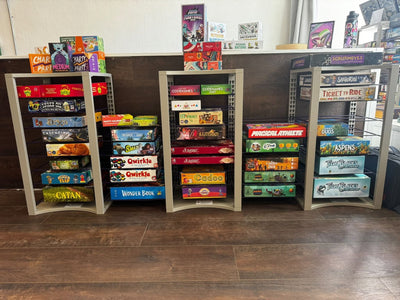
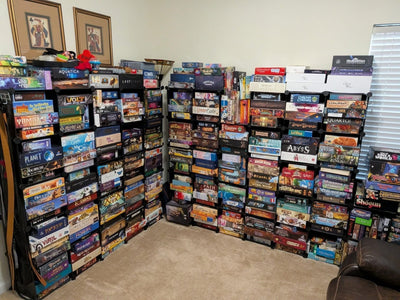
A great gaming table solves where you play - but a growing collection still needs somewhere to live. →
FAQ
Are board game tables worth it?
For frequent players, they can be. Their biggest advantages are usually a recessed play area, the ability to preserve unfinished games, dedicated gaming surfaces, and integrated accessories. If you mostly play shorter games and your dining table already works well, a dedicated table may not offer enough benefit to justify the cost.
Can a board game table also be used as a dining table?
Yes. Many gaming tables use removable tabletop panels, often called toppers, to cover the recessed gaming area and create a conventional dining surface.
What size board game table should I buy?
Start with your typical player count and the games you actually play. Measure your largest games while they're set up, then make sure players can comfortably reach the center of the table. Also account for chairs and walking clearance around the table.
Do I need a board game table if I already have a dining table?
Not necessarily. If your dining table comfortably fits your games and you rarely need to preserve unfinished sessions, it may already be the right solution. A dedicated gaming table becomes more useful when it solves recurring problems your dining table can't.