Beyond the KALLAX: 7 Better Ways to Store a Growing Board Game Collection in 2026
As a board game collection grows, fixed cube storage can become harder to use efficiently. Oversized boxes, expansions, small games, heavy campaign titles, and changing storage needs all create new challenges. This guide explores seven ways to move beyond traditional cube shelving and build a storage setup that is easier to access, organize, and expand over time.
Table of Contents
- Move Beyond Fixed Cubes with Adjustable Shelving
- Give Individual Games Their Own Shelf Space
- Consider Horizontal Storage for Component-Heavy Games
- Create Dedicated Storage for Oversized Games
- Organize by How You Play, Not Just by Box Size
- Use Small-Game Storage to Recover Wasted Space
- Think Modular Before Your Next Shelf Is Full
- KALLAX vs. Dedicated Board Game Shelving
- What to Look for in a Board Game Storage System
- From Furniture to a Board Game Storage System
- A Better Shelf Can Make Your Games Easier to Play
- Frequently Asked Questions
If you’ve been collecting board games for a while, there’s a good chance your collection has spent at least part of its life in an IKEA KALLAX.
The KALLAX is affordable, widely available, easy to assemble, and its cube-shaped compartments happen to fit a surprising number of board game boxes. For a small or medium-sized collection, it can be an excellent solution.
But board game collections rarely stay the same size.
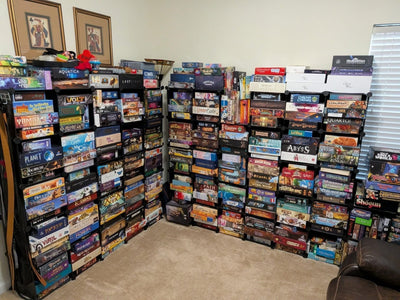
One shelf becomes two. Small boxes start filling the gaps between larger games. Then come oversized campaign games, deluxe editions, expansions, miniature-heavy boxes, and games that seem designed specifically to ignore normal furniture dimensions. Eventually, the question changes from "Where can I put my board games?” to “How can I organize my collection so I can actually access and enjoy it?”
If your collection is reaching that point, here are seven ways to rethink board game storage in 2026 - and what to look for when moving beyond the traditional cube shelf.
1. Move Beyond Fixed Cubes with Adjustable Shelving
One of the biggest limitations of cube storage is right there in the name: every cube is the same size.
Board games aren't.
A fixed compartment might fit three medium games perfectly while leaving several inches of unused space above them. Another compartment may struggle to accommodate a single oversized game.

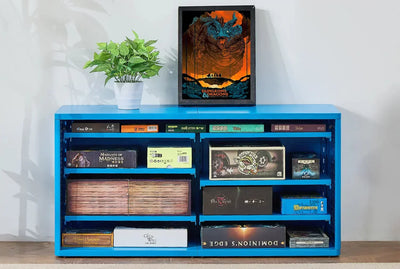
Adjustable shelving solves this by allowing the shelf spacing to follow your collection rather than forcing your collection to follow the furniture.
For example, you might create:
- narrow spaces for standard board game boxes;
- taller spaces for oversized or deluxe games;
- dedicated sections for expansions;
- smaller compartments for card games and accessories.
As your collection changes, the shelving can change with it.
Why it matters
For serious collectors, storage density isn't simply about how many cubic feet of furniture you own.
It's about how much of that space is actually usable.
Adjustable shelves can dramatically reduce the dead space created when fixed cubes and irregular game boxes meet.
2. Give Individual Games Their Own Shelf Space
Picture this:
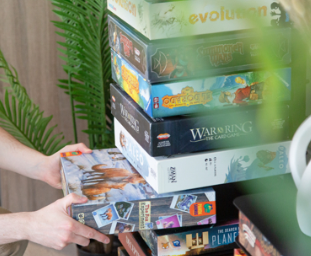
The game you want tonight is sitting at the bottom of a stack of six boxes.
You carefully remove five games, pull out the one you want, then rebuild the stack.
Later that evening, you do the whole thing again.
It's a small inconvenience, but it's one board game collectors know very well.

A different approach is to use more closely spaced adjustable shelves so individual games - or small groups of similarly sized games—have their own shelf space.
Instead of:
one compartment → one large stack
You move toward:
one shelf → one game
or:
one shelf → a small, easily removable group
This can make a surprisingly large difference in how a collection feels to use.
Games slide in and out more easily, stacks don't need to be rebuilt, and heavy boxes don't have to sit on lighter ones.
For frequently played games, that accessibility can matter just as much as storage capacity.
3. Consider Horizontal Storage for Component-Heavy Games
Few board game storage debates are as persistent as this one:
Should board games be stored vertically or horizontally?
Vertical storage has obvious advantages.
Games can be displayed like books, individual boxes are easy to remove, and shelves often look cleaner.
But vertical storage isn't ideal for every game.
If a box contains loose tokens, cards, trays, miniatures, or an organizer that doesn't hold everything tightly in place, standing the game vertically can allow components to move around inside.
You know the result.
You open the box and discover that the carefully organized components have recreated a small natural disaster.

Horizontal storage can help avoid that problem, particularly with:
- component-heavy strategy games;
- games with removable trays;
- miniature games;
- campaign games;
- heavy deluxe editions;
- games with loosely packed inserts.
The downside, traditionally, is stacking.
Horizontal storage keeps components flat, but if five games share one stack, you have to move four to reach the bottom one.
That's why horizontal storage works particularly well when combined with closely spaced adjustable shelves.
You get the benefits of storing games flat without creating giant stacks.
So which is better?
There isn't one correct answer.
For many collections, the best solution is a hybrid:
Vertical storage for games that tolerate it, horizontal storage for games that benefit from staying flat.
Your furniture should ideally allow both.
4. Create Dedicated Storage for Oversized Games
Modern hobby games have a habit of becoming enormous.
Kickstarter and deluxe editions have pushed board game packaging far beyond the traditional square box. Some games now arrive in boxes large enough to become furniture themselves.
Trying to force those games into standard cubes often leads to awkward solutions:
- boxes sticking out from the shelf;
- games stored on top of furniture;
- wasted space around oversized boxes;
- heavy games placed in inconvenient locations.
Instead, plan dedicated oversized-game zones.
Adjustable shelving makes this much easier because one section can have significantly more vertical clearance without forcing the entire shelving unit to use the same spacing.
It's also worth thinking about weight.
Your largest games are often your heaviest games, so storing them lower can make them easier—and safer—to move.
That giant campaign box probably doesn't need to live six feet above the floor.

5. Organize by How You Play, Not Just by Box Size
Many collections are organized purely around whatever fits.
There's another option:
Organize around how you actually choose games.
You might create sections for:
- two-player games;
- family games;
- party games;
- solo games;
- campaign games;
- heavy strategy games;
- frequently played favorites;
- games waiting to be played.
You can also dedicate a shelf to your current rotation.
Think of it as the board game equivalent of a “Now Playing” list.
Instead of browsing 150 boxes every Friday night, your group has a small selection of games you've already decided you want to get to.
This turns shelving from passive storage into part of the way you use your collection.
6. Use Small-Game Storage to Recover Wasted Space
Large boxes aren't always the biggest storage problem.
Small games are.
Card games and compact boxes have a tendency to disappear inside shelving designed for much larger products. Putting a tiny game alone in a large cube wastes space, while stacking dozens together can make individual titles difficult to find.
Consider creating a dedicated small-game section using:
- shallow shelves;
- bins;
- drawers;
- labeled containers;
- smaller adjustable compartments.
The important principle is simple:
Don't force every game into the same storage format.
A good collection has different storage needs at different scales.
Large campaign boxes, standard games, small card games, expansions, playmats, and accessories don't necessarily belong on identical shelves.
7. Think Modular Before Your Next Shelf Is Full
This might be the most important lesson for growing collections.
Don't only buy storage for the collection you have today.
Think about the collection you'll probably have two years from now.
If you own 60 games and your new shelving fits exactly 60 games, you've already created your next storage problem.
Modular systems can make expansion easier.
Instead of replacing an entire setup, you may be able to add another section, adjust shelf spacing, or reorganize individual areas as your collection changes.
Before choosing a storage system, ask:
Can I adjust it?
Can I expand it?
Can it accommodate different box sizes?
Can I store games both horizontally and vertically?
Can I easily remove one game without disturbing the others?
Those questions matter more over time than simply asking how many games fit on the shelf today.
KALLAX vs. Dedicated Board Game Shelving
So, does all of this mean you should get rid of your KALLAX?
Not necessarily.
The KALLAX remains popular because it solves a lot of problems at a relatively low cost.
For many collections, that's exactly what is needed.
But the trade-offs become more noticeable as collections grow.
| Feature | Cube Storage | Dedicated Board Game Shelving |
|---|---|---|
| Affordable entry point | Excellent | Varies |
| Standard game boxes | Good | Excellent |
| Adjustable shelf height | Limited | Strong |
| Oversized games | Limited | Strong |
| Individual horizontal storage | Limited | Strong |
| Small-game optimization | Moderate | Configurable |
| Expansion flexibility | Moderate | Depends on system |
| Designed specifically for board games | No | Yes |
The question isn't really:
“Is dedicated board game shelving better than KALLAX?”
It's:
“At what point does dedicated storage become more useful for my collection?”
For someone with 20 games, the answer may be never.
For someone with 100 games of wildly different sizes, the answer can be very different.
What to Look for in a Board Game Storage System
If you're shopping for a dedicated solution, focus less on marketing photos and more on how the system works with your actual games.
Adjustable shelf spacing
This is especially valuable when your collection includes both standard and oversized boxes.
High weight capacity
Modern board game collections get heavy quickly. Check both total capacity and the capacity of individual shelves.
Horizontal and vertical flexibility
You shouldn't have to choose one storage philosophy for every game you own.
Easy access
Ideally, removing one game shouldn't require reorganizing five others.
Modular expansion
Collections grow. Storage should be able to grow with them.
Appropriate depth
A shelf that's too shallow leaves boxes hanging over the edge. One that's unnecessarily deep consumes valuable room space.
Stability
Tall shelving loaded with heavy board games needs to be stable and, where appropriate, securely anchored according to the manufacturer's instructions.
From Furniture to a Board Game Storage System
This is where dedicated board game shelving becomes interesting.
Traditional furniture is designed to store many different household objects.
Dedicated board game storage starts with the game box itself.
Systems such as BoxThrone, GameKeep, and GamePillar take different approaches to modular and adjustable board game storage, with configurations designed around collections rather than general household shelving.
The goal isn't simply to fit boxes into furniture.
It's to create a setup where standard games, oversized games, small boxes, expansions, and future additions can coexist without forcing the entire collection into identical cubes.
For collectors who have outgrown fixed-compartment storage, that flexibility can be the biggest upgrade.
A Better Shelf Can Make Your Games Easier to Play
Board game storage can seem like a secondary part of the hobby.
Until you have enough games.
Then you realize how much your storage setup influences which games you notice, which games you can reach, and sometimes even which games you decide to play.
The best storage system isn't necessarily the one that holds the largest possible number of boxes.
It's the one that makes your collection work for you.
For a small collection, that might still be a KALLAX.
For a growing collection, it might mean adjustable shelves, dedicated oversized-game storage, horizontal storage, or a modular system that can evolve over time.
Because the real goal isn't to build a beautiful wall of board games.
It's to get those games off the shelf and onto the table.
Frequently Asked Questions
Is KALLAX good for board game storage?
Yes. KALLAX remains a practical option for many board game collections because its cube dimensions accommodate many common game boxes and the system is relatively accessible. Its main limitation is that fixed cube dimensions can create wasted space or awkward storage as a collection becomes more varied.
Is it better to store board games vertically or horizontally?
It depends on the game. Vertical storage makes individual boxes easier to access, while horizontal storage can help keep loose components and inserts in place. A flexible storage system that supports both orientations is often the best option.
How do you store oversized board games?
Oversized games are generally easier to manage on adjustable shelves with enough width, depth, and weight capacity. Heavy oversized games are often best stored lower in the shelving unit.
How should I organize a large board game collection?
You can organize by game type, player count, frequency of play, box size, or a combination of these. For large collections, adjustable shelving and dedicated areas for oversized and small games can make the collection easier to access.
When should I upgrade to dedicated board game shelving?
Consider upgrading when fixed shelving creates significant unused space, games become difficult to access, oversized boxes no longer fit comfortably, or your collection is growing faster than your current storage can accommodate.