
How Many Board Games Is Too Many? (And What To Do About It)

In my dreams, I own a board game collection numbered in the thousands, including the highest-rated games on BoardGameGeek, the latest releases, and all the wonderful games I’ve tried at conventions, game nights with friends, and board game cafes and clubs.
They are stored in a palatial library like the one in Beauty and the Beast, with shelves that never end, rolling ladders, and a magical organization system that lets me pick out just the right game every time.
In my nightmares, I have to pay for the games, organize them, and afford the mortgage payments on the house that has that big a library!
Table of Contents
How Many Board Games Is Too Many?
For most of us, our board game collection is limited by our wallets and the space we have at home.
I think it's fair to say that if you have so many games that you can’t see your floor, that’s probably too many.
Alternatively, if you only have a pack of cards and a copy of Scrabble, this article isn’t for you.
So, how many games is too many?
This will vary considerably depending on your circumstances and why you collect games.
Some collect to play, others collect, and some hold on to games for sentimental reasons.
I still have a copy of Dragonlance, the first game I ever bought, and games I played with my wife on our honeymoon, even though I’m unlikely to play any of them again.
Still others dare not miss out on the latest Kickstarter projects or buy games to trade or sell.
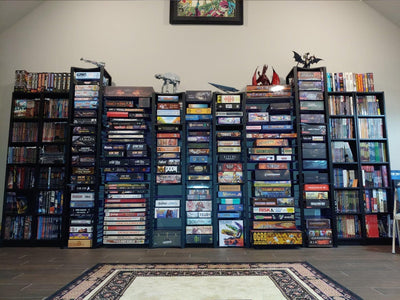
Storage systems like BoxKing board game storage shelves or the ubiquitous Kallax can help you make the most of your space, but at some point, there’s just no more room.

Signs You Have Too Many Board Games
Time to go
You realize you have over 500 games, or you’ve got so many that they’re on every flat surface in your home and there’s nowhere to put any more—what now?
It’s time to get rid of some of them (especially if you’re waiting on several Kickstarters).
Shelf of shame
Most board gamers have a “shelf of shame” where games they’ve acquired but never played slowly gather dust.

As a rule of thumb, if I’ve owned it for more than six months and haven’t played it, I consider clearing it out. If it's been a year or more, it can go.
One-play wonder
In a similar vein, some games get played once and never returned to.
It's often tempting to keep hold of this type of game, planning to give it another go, but in my experience, that rarely happens.
Replaced
Some games naturally replace others. If whenever you think of playing a game, you want to play another game instead, you’ve found a game that has been replaced.
How to Decide What Board Games to Keep
Keep breadth

When considering board games to dispose of, consider how many similar games you have in your collection.
If it’s your only social deduction game, your only co-op, or your only example of any other mechanic, perhaps it gets to stay.
The same applies to player counts and game length.
I’ve played Captain Sonar exactly twice, but it stays in my collection because it is such a unique experience.
Where Do Board Games Go?
Online Markets
The first option is to sell them and hopefully recover some of your investment (to buy more games, of course). Places like Facebook Marketplace and eBay can be great options for selling more mainstream or hobby games with a strong resale market, but games are often undervalued as people look for bargains.
The advantage here is the size of the audience; you can reach people looking for your game who would otherwise never find it.
Bring and Buy
If you’re lucky, your local games shop or a convention you’re attending may have a bring-and-buy. These can be better for getting more for your games, as your market is almost exclusively for hobby gamers who understand the original price.
For me, the danger is always that I end up buying more than I sell.
<<<My latest pick-ups at a Bring and Buy>>>
Maths trades
Another option is to look to trade games. This can be done on a 1-1 basis, but math trades give you a much wider choice of potential games to trade for.
Math trades are organized around events and location but can be hard to find. The way they work is that you list a game you want to trade, then view all the other games available, marking which ones you would trade that game for.
It may be that the owners of those games might not want what you’re trading, but they do want something from another participant who wants what you have. For example, I have a copy of Dominion I want to trade for Ben’s Agricola. Ben doesn’t want Dominion, but he does want Colt Express that Christina is trading, and Christina wants Dominion. I give Christina Dominion, she gives Ben Colt Express, and Ben gives me Agricola.
In reality, a computer algorithm is used to make as many trades as possible among participants, which can create very long, complex chains of trades.
The drawback here is that you have to send (usually by post) or hand over a game without getting anything in return. There is a lot of trust involved, and while the community is pretty well self-regulated, you are taking a risk.
Donations
You might also consider a library, a games cafe, or a charity and donate them, or, if you know a designer like me, offer it to them to harvest for parts.
Final Thoughts
This isn’t a set of hard-and-fast rules, and as someone with over 350 games in my home, I’m in no position to tell anyone how many games they can have!
So, what’s your count?


Marc Kenobi
