Board Game Cart vs. Side Table: Which Do You Need?
You set up a game. The main board fits. The player boards fit. Then the token trays come out. Then the rulebook. Then the expansion box because you need three cards from it this scenario. Then someonae puts a drink down because there’s nowhere else.
Within ten minutes, the play area is a negotiation. You’re sliding the resource pile to make room for a card row. Someone’s player aid is on their lap. The rulebook is on a chair.
The instinct is to blame the table. Sometimes that’s correct. Sometimes, the missing piece is simply a place for items that don’t need to occupy the playing surface.
This isn’t a storage guide. It’s a guide to the space immediately around you during a session.
Table of Contents
First, Diagnose What’s Actually Happening
Before deciding whether you need a side surface or a cart, answer one question honestly: Is the game itself too big for this table, or is the game fine and other things are taking up space?
Here’s a quick test.
Step 1: Set up the game as you normally would, with everything you expect to use during the session – main board, player areas, card rows, token pools, reference materials you’ll actually consult. Leave room for cards, tiles, and player areas that will expand as the game progresses.
Step 2: Remove only the things that are definitively not part of play: the empty box, the lid, the plastic bags you just emptied, the expansion box you’re not touching this game, personal items unrelated to the session.
Step 3: Look at what’s left. Can every player see the main board? Can they reach the common resources without standing up? Is there room to actually move components around as the game state changes?
If the answer is yes, then this table works for this game with this number of players. You’ve identified an overflow problem, and a side surface or cart can solve it.
If the answer is still no, the cause matters. There are three distinct problems that get mistaken for “the table is too small”:
- Not enough expansion space: the game genuinely needs more play surface as it develops. A larger usable playing area may be justified.
- Visibility or reach problems: components are on the table but can’t be seen or reached comfortably. Before buying a bigger table, adjust seating, table orientation, where common components sit, and how wide the play area is. A larger table can actually make reach worse if it pushes players further apart.
- Packaging and non-play items occupying space: the game fits, but boxes, bags, and unrelated items are in the way. Move those to an auxiliary surface.
Separating these three is the whole point of the diagnostic.
Where Things Go: A Simple Allocation Principle
Once you’ve diagnosed the issue, assign every item to one of three roles based on how often it’s used and by whom – not based on which piece of furniture you own.
| Location | Allocation principle | Typical items |
|---|---|---|
| Main play surface | Needs continuous visibility, frequent handling, or shared judgment | Main board, player boards, common card row, active resource pool |
| Auxiliary surface – side table or cart top | Used occasionally but needs to be within easy reach | Rulebook, backup components, reference sheets, occasionally-used tokens |
| Temporary holding area – cart lower shelf, shelving, or another spot | Not involved in this session’s play | Empty box, lid, packaging bags, unused expansion content |
The auxiliary surface can be a side table or a cart. A stable cart with a suitable top height can hold the rulebook and resource trays just as well as a side table. A side table can temporarily hold an empty box. What matters is height, proximity, and whether the surface is stable enough for what you’re putting on it.
Phones and personal items aren’t automatically excluded from the play surface – some games use a phone for timers, rules lookup, or companion apps. The principle is “unrelated to this session,” not “anything with a screen.”
Side Table vs. Cart: How to Choose
If you don’t already have a suitable nearby surface, the choice between a side table and a rolling cart comes down to how you use the room.
| Decision factor | Side table | Rolling cart |
|---|---|---|
| Best for | A fixed seat that needs a nearby surface throughout the session | Shared or multi-use spaces where the setup needs to be moved as a unit afterward |
| Main advantage | Simple surface, direct access | Layered storage and consolidated transport |
| Main trade-off | Storage capacity and mobility depend on the specific piece | Stability, wheel locking, and access to lower shelves need checking |
| When you don’t need to buy one | You already have suitable adjacent furniture | You don’t need mobile storage, or you have no suitable place to park it. |
The right choice depends on your room, your seating, and whether the setup needs to disappear between sessions. If you’re considering a cart, check its dimensions, shelf configuration, and how it moves before deciding – those details matter more than the category label.
When One Piece Can Do Both
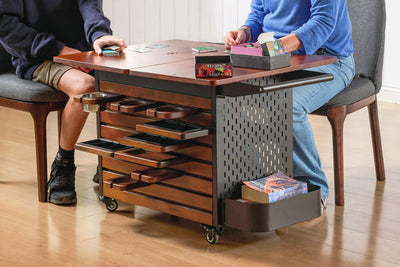
If you want a side surface during play and mobile storage afterward, the BoxKing MultiCart with the optional folding tabletop combines both roles. Keep the solid wood top folded for a compact side surface, with game boxes and supplies stored below. The top also unfolds when you want a larger surface.
For this use, choose Cart + Folding Tabletop. The Cart Only configuration is the option for players who primarily want mobile storage. A suitable side table you already own may still be all you need; the tabletop-equipped MultiCart makes sense when you want that surface and your stored equipment to move together.

Two Worked Setups: Pick the One That Matches Your Room
Both examples use the same four-player game: a central board, four player boards, a shared card row, a token pool, and one rulebook.
Setup A: You already have a side table
On the play surface: Main board. Four player boards arranged around it. The card row, positioned so every player can see it. The token pool, within reach of at least two players. Small personal player aids if the game provides them.
On the side table: The rulebook, positioned between two players at a comfortable working height. Occasionally-used components that will be needed once or twice. A drink, if the side table is stable and positioned so that no player has to reach across it to get to rules or paper components – and it isn’t crowded onto the same small surface as the rulebook.
Back to the shelf or another fixed spot: The empty box, lid, bags, and the expansion box not in use this session. These don’t need to be in the room at all if you have a place to put them.
Setup B: You need to clear the whole setup afterward
On the play surface: Same as above – main board, player boards, card row, token pool.
On the cart’s top shelf: The rulebook, occasionally-used components, and anything else that needs to be reachable during play.
On the cart’s lower shelf: The empty box, lid, bags, and unused expansion content.
After play: Pack the active components back into their boxes, load them onto the cart, and move it to its parking spot. The cart keeps the packed materials together; it does not preserve the game’s layout.

Choose around your room and routine. An existing side table may cover your needs if you have somewhere else to put the packed games. A cart is useful when you also want to move those materials together; a tabletop-equipped cart can serve as the side surface during play.
When a Bigger Table Is Actually the Answer
This framework isn’t an argument against large tables. It’s an argument against buying one for the wrong reason.
If you run the diagnostic and the game genuinely lacks expansion space – the play area can’t accommodate the board as it grows, or the number of players the game supports – then a larger usable playing area may be justified.
But if the problem is visibility or reach, start with seating and layout before shopping. And if the problem is overflow, a side table or cart solves it without changing the table at all.
The Takeaway
Before you shop for a bigger table, spend one session paying attention to what’s actually taking up space. Separate what the game needs from what the box brought with it. Give the overflow somewhere to go that isn’t the play surface.
A crowded table can mean different things. Make sure you know which one you’re dealing with before you buy anything.
Need a side surface that can move with your game-night supplies? Explore the BoxKing MultiCart and its optional folding tabletop to see which configuration fits your setup.