Are Board Game Expansions Worth It? Lessons from Reddit Players
You enjoy a game. Its expansion promises more characters, more strategies, or a new way to play. Buying it feels like a natural next step.
Sometimes it is. Other times, the larger collection becomes harder to teach, slower to prepare, and less likely to reach the table.
In a Reddit discussion about expansion regrets, players describe unused purchases, preferred subsets of larger collections, and differing opinions about the same content. An earlier discussion of rarely used expansions draws a useful distinction between adding familiar variety and adding rules that change the experience.
The question is not whether expansions are good. It is whether a particular expansion improves the way your group actually plays.
Table of Contents
- Start with something you want the base game to do differently
- Distinguish new possibilities from new procedures
- Match the expansion to the players you really have
- Keep the base game easy to access
- Consider the full game-night footprint
- Treat complete collections as a choice, not a destination
- Use reviews to identify a match, not a universal verdict
- Buy the expansion for the next sessions you want to have
Start with something you want the base game to do differently
An expansion has a clear purpose when it addresses a specific need.
Perhaps your regular group has explored the existing characters and wants fresh combinations. Perhaps you want a supported solo mode, a new campaign, or a different player count.
“I want more because I like this game” is understandable, but it gives you less guidance about which expansion to choose.
Try finishing this sentence: “We would play this game more often if…”
If the answer is more variety, look for variety. If the answer is finding an evening when everyone is free, additional content may not solve that problem.
Distinguish new possibilities from new procedures
Some expansions add cards, maps, or characters while leaving the familiar turn structure largely intact. Others introduce separate phases, resources, boards, or scoring rules.
Both approaches can be enjoyable. They ask different things from the group.
A group that plays the same game repeatedly may welcome additional systems. A host who frequently teaches newcomers may prefer content that can be left out without reorganizing the entire box.
Read the expansion's rules with the teaching process in mind. What would you need to explain before the first turn, and what would interrupt play later?
Match the expansion to the players you really have
An expansion that adds seats is useful only if that larger group is likely to gather and enjoy the resulting session.
Likewise, a solo mode is valuable if you want to play alone, rather than simply like having the option. A demanding campaign needs players willing to return.
Player count on the box does not tell you how your group will experience the game. Additional participants may change downtime, interaction, session length, or the amount of table space required.
Look for reports from players with similar circumstances, while remembering that their preferences may differ from yours.
Keep the base game easy to access
An expansion should not make the version you enjoy most unnecessarily difficult to prepare.
If your group sometimes plays without it, keep optional cards and components identifiable. Store its rules with those pieces. Follow the publisher's instructions when separating content, especially if symbols or replacement cards determine what belongs in each configuration.
A collection can be complete without being permanently mixed together.
This also makes teaching easier. You can introduce the base game without first searching through every extra module you own.
Consider the full game-night footprint
The expansion's storage box is only one part of the space it uses.
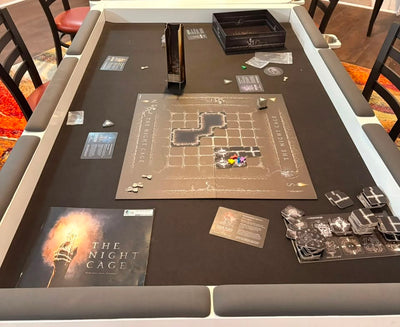
An extra board, larger card market, or additional player area can change the table layout. More components can also change preparation and cleanup.
Picture the version you expect to play: the usual number of people, their personal areas, and the shared materials. Ask whether the expansion adds an interesting decision or mostly adds handling for your group.
A larger setup can be worthwhile. It should be something you actively want to play, rather than an obligation created by the purchase.
Treat complete collections as a choice, not a destination
There is nothing wrong with enjoying a comprehensive collection. The difficulty comes when collecting every release becomes disconnected from the sessions you actually have.
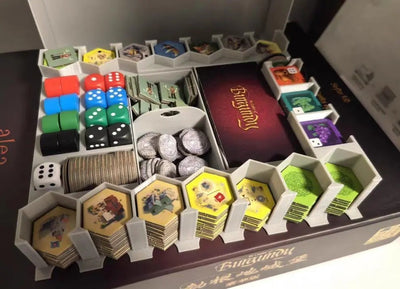
A big box may conveniently gather content. It may also make a simple base-game session feel more cumbersome if frequently used pieces are buried among optional material.
Before consolidating, decide what needs to be immediately accessible. You may prefer a compact core-game arrangement and separate storage for less-used modules.
Keeping a smaller selection can be a positive preference, not a failure to experience the game properly.
Use reviews to identify a match, not a universal verdict
A negative comment can reveal a useful limitation: a module adds more teaching, changes a favorite mechanism, or introduces a style of play that the commenter dislikes.
That does not prove the expansion is bad. The same change may be exactly what another group wants.
Compare the reason behind the opinion with your own priorities. Reports of complexity matter more when you regularly teach beginners; reports of additional variety matter more when your group has played the base game repeatedly.
Buy the expansion for the next sessions you want to have
A good candidate answers a clear need, suits your regular players, and leaves you willing to set up the game again.
If you are still discovering the base game, you can wait. If one module becomes a favorite and the others stay in the box, you can use that subset.
The strongest reason to add an expansion is that you can describe the experience it will make possible—and you want that experience enough to bring it to the table.